

What Is a Calibre in a Watch?
We make things that work better and last longer. Our products solve real problems with clean design and honest materials.
Calcutta Watch Company | Kripanti Maity
The Story, History and Heart Behind Every Movement
Every watch has a face. But its real story begins behind it.
Beneath the dial, hidden under layers of metal, gears, springs and microscopic components, lives the mechanism that gives a watch its heartbeat. It powers the hands. It measures the passing seconds. It determines how the watch performs, how it is serviced and, often, how it is remembered.
In the language of horology, this mechanism is known as the calibre.
You may have seen the word in a watch specification:
Calibre 2824-2.
Calibre 3135.
Calibre 321.
Calibre 3235.
To a newcomer, these numbers may appear technical and mysterious. To a watchmaker or collector, however, a calibre number can tell an entire story.
It can reveal the architecture of a movement, its era, its complications, its frequency, its dimensions and sometimes even the philosophy of the company that created it.
So, what exactly is a calibre in a watch?
And how did a word once associated with measurement become one of the most important words in the world of watchmaking?
This is the story of the calibre — the invisible identity at the heart of a timepiece.
What Does “Calibre” Mean in a Watch?
In modern watchmaking, the word calibre — also spelled caliber in American English — generally refers to a specific watch movement or a particular design of movement.
Simply put:
The watch is the complete timepiece. The calibre is the mechanism inside that makes it work.
But there is an important distinction.
The word does not merely mean any movement. A calibre usually identifies a specific movement design or family, often with its own reference number or designation.
For example, if a movement is called Calibre 2824-2, the name identifies a particular movement architecture with its own specifications, dimensions and mechanical characteristics.
Think of it like an engine in a classic automobile.
Two cars may look completely different on the outside, yet share the same engine. Similarly, two watches may have different cases, dials, straps and brand identities while using the same underlying calibre.
The exterior tells you what you see.
The calibre tells you what makes it live.
The Meaning Before the Movement
The story of the word calibre is older than modern wristwatches.
Historically, the term was connected with measurement, dimensions and physical form. Its linguistic journey passed through French usage and was ultimately associated with the idea of a mould, gauge or standardized dimension.
In watchmaking, the word was initially much closer to its original meaning than it is today.
A calibre could describe the layout, dimensions and physical architecture of a movement.
The placement of the pillars mattered.
The arrangement of the wheels mattered.
The size of the barrel mattered.
The shape of the bridges mattered.
In other words, before calibre became the name of the movement itself, it helped describe the physical identity of the mechanism.
This historical evolution is one of the reasons the word remains so fascinating. It is not simply a label invented for marketing. It emerged from the practical language of watchmaking itself.
The Fondation de la Haute Horlogerie traces horological use of the term to around 1715, when English clockmaker Henry Sully, working in France, used it in relation to the layout and dimensions of movement components. Over time, the meaning expanded and eventually came to designate the movement itself.
From Size to Identity
Early watch movements were often identified by their physical size.
This made perfect sense.
In the age of pocket watches and early mechanical production, a movement had to fit inside a particular case. Its diameter was therefore one of its most important characteristics.
Historically, movement sizes were often measured in lignes, an old French unit still encountered in traditional horology. One ligne is approximately 2.256 millimetres.
A movement might therefore be described by its diameter:
10'''
12'''
16'''
These measurements helped watchmakers understand the physical dimensions of the mechanism.
But watchmaking became increasingly complex.
Two movements of a similar diameter could have completely different designs.
One could have a small seconds display.
Another could include a chronograph.
Another could feature a calendar.
Another could have a completely different bridge architecture.
As mechanical designs multiplied, size alone was no longer enough to identify a movement.
The calibre began to evolve from a description of dimensions into something more specific:
a name for a particular movement design.
And that is essentially how we understand the word today.
The Calibre Is the Heart of the Watch
Calling the movement the “engine” of a watch is useful, but perhaps not quite poetic enough.
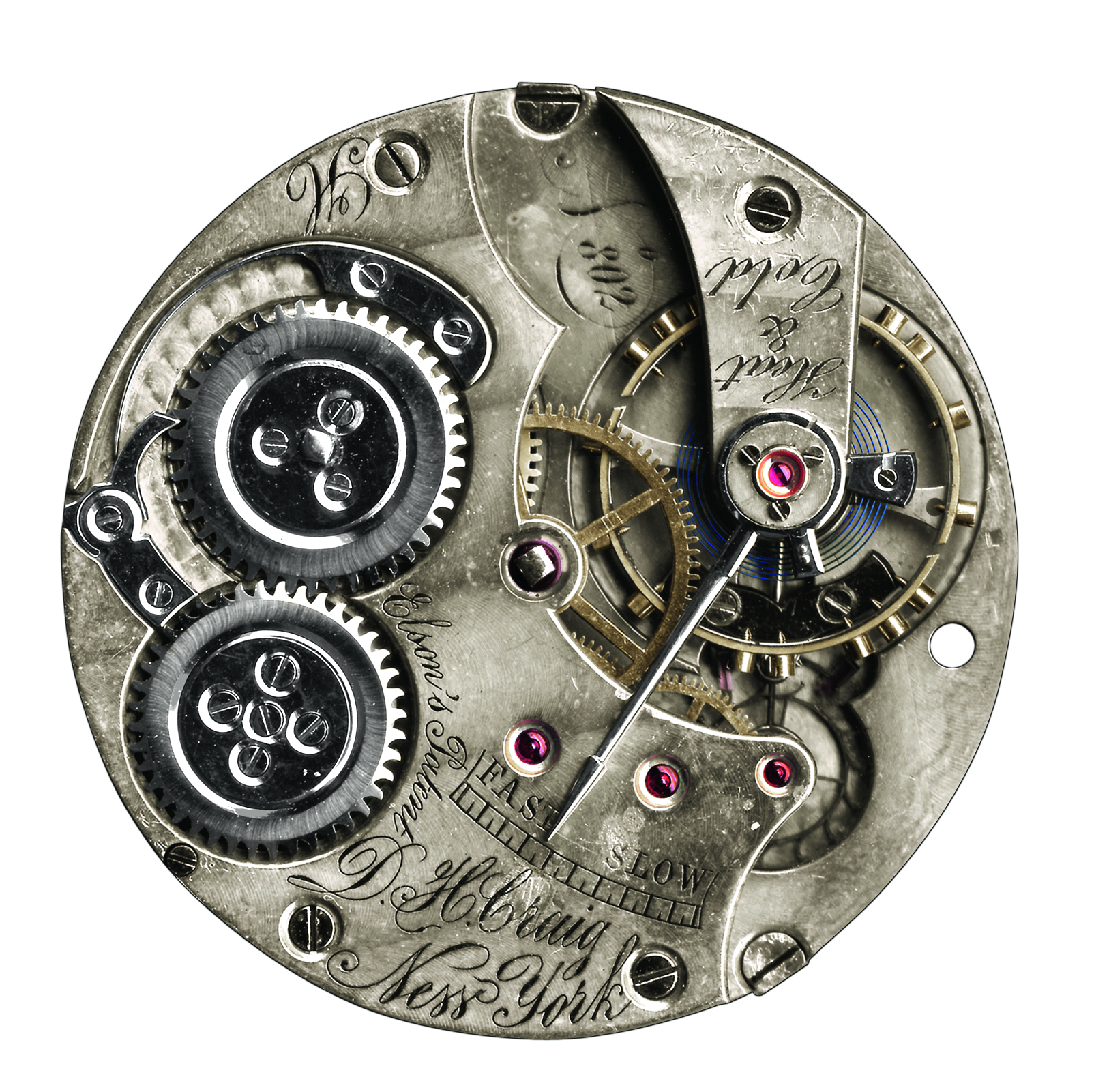
A mechanical calibre is closer to a tiny mechanical ecosystem.
Energy is stored.
Energy is released.
Gears transfer power.
An escapement controls that release.
A balance oscillates.
The hands move.
And all of this happens continuously, inside an object small enough to sit on your wrist.
A traditional mechanical calibre may contain dozens or even hundreds of components.
Depending on its complexity, these can include:
-
Mainplate
-
Bridges
-
Mainspring
-
Barrel
-
Gear train
-
Escapement
-
Balance wheel
-
Hairspring
-
Jewel bearings
-
Winding mechanism
-
Rotor in automatic movements
-
Calendar components
-
Chronograph mechanisms
-
Additional complication systems
Every component has a purpose.
Every component must work in harmony.
A fraction of a millimetre can matter.
A tiny amount of incorrect lubrication can matter.
A microscopic component, almost invisible without magnification, can determine whether a movement runs accurately or stops altogether.
That is the extraordinary nature of a calibre.
It is engineering compressed into time.
How Does a Mechanical Calibre Work?
To understand why collectors care so deeply about calibres, it helps to understand what happens inside one.
1. Energy Is Stored
In a mechanical watch, energy is generally stored in a tightly wound mainspring.
When you wind a manual watch, you tighten the mainspring through the crown.
In an automatic watch, the movement of your wrist turns a rotor, which helps wind the mainspring.
This stored energy is the power source of the watch.
2. The Barrel Releases Energy
The mainspring sits inside a component known as the barrel.
As the spring slowly unwinds, it releases energy into the movement.
But this energy cannot simply be released all at once.
If it were, the watch would not measure time.
It would simply unwind.
The energy must be controlled.
3. The Gear Train Transfers Power
A sequence of carefully calculated gears transfers energy through the movement.
This gear train ultimately drives the hands.
The different gear ratios are what allow:
-
The seconds hand to move at its required rate
-
The minute hand to complete a full rotation every hour
-
The hour hand to complete a full rotation every twelve hours
This is mathematics transformed into machinery.
4. The Escapement Controls Time
The escapement is one of the most important inventions in mechanical timekeeping.
Its job is to release energy in controlled increments.
Instead of allowing the mainspring to release its power immediately, the escapement divides that energy into tiny, regulated impulses.
This is one of the reasons a mechanical watch produces its characteristic ticking sound.
5. The Balance Wheel Creates the Rhythm
The balance wheel and hairspring form the regulating heart of a traditional mechanical watch.
The balance oscillates back and forth at a precise rate.
This oscillation determines the rhythm of the movement.
You may see a movement described by its frequency:
-
18,000 vibrations per hour
-
21,600 vibrations per hour
-
28,800 vibrations per hour
-
36,000 vibrations per hour
A higher frequency generally means the regulating system is oscillating more rapidly, though frequency alone does not automatically determine whether one movement is better than another.
Watchmaking is rarely that simple.
A calibre is always a combination of architecture, engineering, materials, regulation, finishing and execution.
Manual, Automatic and Quartz: Different Types of Calibres
The word calibre is most commonly associated with mechanical watch movements, but it can also be used for specific quartz movement designs.
The major movement categories include:
Manual-Winding Calibres
A manual-winding calibre requires the wearer to wind the watch using the crown.
The experience is wonderfully direct.
You are not simply wearing the watch.
You are participating in its operation.
Each turn of the crown stores energy inside the mainspring.
For many collectors, this daily interaction is part of the charm.
A manual movement can also allow for beautiful movement architecture because there is no automatic rotor covering the mechanism.
Automatic Calibres
An automatic calibre is still mechanical.
The difference is that it uses an oscillating weight, commonly known as a rotor, to help wind the mainspring through the movement of the wearer.
As your wrist moves, the rotor moves.
That motion is converted into stored mechanical energy.
Automatic watches brought a new level of everyday convenience to mechanical timekeeping.
They allowed the beauty of traditional watchmaking to continue while reducing the need for frequent manual winding.
Quartz Calibres
A quartz calibre operates on an entirely different principle.
Instead of relying primarily on a mainspring, escapement and balance wheel, a quartz movement generally uses a battery and an electronically controlled quartz crystal oscillator.
Quartz movements transformed the watch industry by offering remarkable accuracy and affordability.
They also made it possible to create extremely slim, practical and mass-produced watches.
But being electronic does not make a quartz calibre unimportant.
Like mechanical movements, quartz movements also have specific architectures, reference numbers and technical identities.
The movement remains the heart of the watch — only the heartbeat has changed.
Modern watch education commonly categorizes movements into manual mechanical, automatic mechanical and quartz families, each with its own operating principle and construction.
Why Does Every Calibre Have a Number?
This is where the world of watch collecting becomes especially interesting.
A calibre number is essentially an identity.
It helps distinguish one movement design from another.
For example:
ETA 2824-2
Valjoux 7750
Omega 321
Rolex 3135
These are not simply random numbers.
To collectors and watchmakers, they can represent particular chapters in horological history.
A calibre reference can tell you about:
-
The movement's manufacturer
-
Its basic architecture
-
Its generation
-
Its functions
-
Its dimensions
-
Its technical family
-
Its service requirements
-
Its historical importance
This is why the movement reference is often one of the first things an experienced collector wants to know.
The case may tell you the style.
The dial may tell you the personality.
The calibre tells you what is actually inside.
Famous Calibres and Why They Matter
Some watches are remembered because of their design.
Others are remembered because of the calibre beneath the dial.
And occasionally, a movement becomes more famous than the watch that originally carried it.
ETA 2824-2 — The Everyday Mechanical Workhorse
Few modern Swiss mechanical movements have become as widely recognized as the ETA 2824-2.
Known for its practical automatic architecture, date function and widespread use, it became a familiar movement across numerous brands and price segments.
Its popularity also helped establish an important idea in modern watch collecting:
A watch does not need to have a completely unique movement to be respected.
Reliability matters.
Serviceability matters.
Availability of parts matters.
A well-engineered calibre that can be maintained over decades can be incredibly valuable to an owner.
Valjoux 7750 — A Chronograph Icon
The Valjoux 7750 became one of the most important automatic chronograph movements in modern watchmaking.
Chronographs are mechanically complex.
They must not only keep time but also measure intervals using an additional timing mechanism.
The 7750 became famous for its robust, industrially proven design and was used as the foundation for numerous chronograph watches.
Over time, it became part of the vocabulary of collectors.
When someone says a watch is powered by a 7750-based movement, they are describing more than a technical specification.
They are describing a mechanical lineage.
Omega Calibre 321 — A Movement with a Story
Some calibres become associated with historic moments.
The Omega Calibre 321 is remembered as one of the legendary chronograph movements of the twentieth century.
Its importance lies not only in its engineering but also in the watches and stories connected to it.
This is where the emotional side of a calibre becomes clear.
The same movement can represent:
-
An era
-
A technical breakthrough
-
A particular manufacturing philosophy
-
A connection to exploration
-
A connection to vintage collecting
A calibre can therefore become part of cultural history.
In-House Calibre vs Outsourced Calibre
One of the most discussed topics in modern watchmaking is whether a movement is in-house or supplied by another manufacturer.
What Is an In-House Calibre?
An in-house calibre is generally a movement designed and manufactured substantially by the watch brand itself, although the exact meaning of “in-house” can vary depending on how a brand structures its manufacturing and supply chain.
For collectors, in-house movements often represent:
-
Technical independence
-
Brand identity
-
Unique engineering
-
Greater exclusivity
-
Higher manufacturing complexity
A movement designed specifically for a brand can become an important part of that brand's identity.
What Is a Third-Party or Supplied Calibre?
Many excellent watches use movements supplied by specialist manufacturers.
This is not automatically a disadvantage.
In fact, some of the most respected watches in history have used externally supplied movements.
A supplied calibre may offer:
-
Proven reliability
-
Easier servicing
-
Wider availability of expertise
-
More accessible spare parts
-
Lower manufacturing costs
The question should not simply be:
“Is it in-house?”
A better question is:
“Is it a good movement for this watch, and how well has it been executed?”
The architecture, quality of finishing, regulation and long-term serviceability can matter just as much as who originally designed the calibre.
The Shape of a Calibre Tells a Story Too
When people imagine a watch movement, they usually imagine a round mechanism.
But calibres are not always round.
Throughout watchmaking history, movements have been designed in many shapes to fit different case designs.
These include:
-
Round
-
Rectangular
-
Square
-
Tonneau-shaped
-
Oval
-
Specially engineered irregular forms
The shape of a movement is not merely decorative.
It influences how a watch is constructed.
A rectangular watch, for example, can contain either a movement specifically designed for its case shape or a smaller round movement placed inside a rectangular case.
Collectors and watchmakers often appreciate purpose-built movements because they demonstrate a deeper level of engineering.
The bridges themselves can also define the visual identity of a calibre.
Historic movement architecture includes bridge designs such as separate bridge constructions, three-quarter plates and other layouts that reveal the design language of a particular era.
Why Jewels Are Used in a Calibre
If you have ever seen a movement engraved with:
17 JEWELS
21 JEWELS
25 JEWELS
you may have wondered whether those jewels are simply decoration.
They are not.
In traditional mechanical watchmaking, jewel bearings are often made from synthetic ruby.
They are used at important points of friction within the movement.
These jewel bearings can help reduce wear and provide durable, low-friction surfaces for rotating components.
The number of jewels does not automatically determine whether a watch is better.
A 35-jewel movement is not automatically superior to a well-designed 21-jewel movement.
What matters is how the jewels are used.
The overall architecture of the calibre is far more important than simply chasing a larger number.
In watchmaking, numbers are meaningful only when they are understood in context.
Why Collectors Care About Calibres
For a casual buyer, the movement may remain invisible.
For a collector, it can be the reason to buy the watch.
A particular calibre may be desirable because it is:
-
Historically important
-
Rare
-
Technically innovative
-
Beautifully finished
-
Highly reliable
-
Easy to service
-
Difficult to manufacture
-
Connected with a famous watch reference
-
Part of a discontinued production line
Sometimes two watches with almost identical external appearances can have dramatically different values because of the movements inside them.
This is why vintage watch collecting can be so fascinating.
The real discovery may begin only after the caseback is opened.
A reference number on a movement can unlock an entire archive of information.
Production period.
Manufacturer.
Technical specifications.
Original applications.
Historical variants.
Replacement parts.
Service instructions.
The calibre is often the key that opens the hidden history of a watch.
How to Identify the Calibre Inside Your Watch
There are several ways to identify a watch calibre.
1. Check the Caseback
Many modern watches list movement information on the caseback or in the accompanying documentation.
However, not every watch displays its calibre externally.
2. Look Through an Exhibition Caseback
A transparent caseback may allow you to see the movement directly.
The calibre number is sometimes engraved or printed on:
-
The mainplate
-
A bridge
-
The rotor
-
Another movement component
3. Check the Manufacturer's Documentation
The official product specification is often the safest source for identifying a modern watch's calibre.
The movement reference may be listed alongside details such as:
-
Power reserve
-
Frequency
-
Number of jewels
-
Winding type
-
Functions
4. Consult a Watchmaker for Vintage Watches
Vintage watches can be more complicated.
A movement may have been replaced, modified or serviced with components from different periods.
For an important vintage watch, opening the case should ideally be done by a qualified watchmaker.
The movement number can then help identify the calibre more accurately.
The Calibre and the Art of Restoration
For vintage watch enthusiasts, the calibre is often the starting point of restoration.
A watchmaker cannot properly service a movement without understanding what movement is being serviced.
Different calibres can require different:
-
Parts
-
Oils and lubricants
-
Service procedures
-
Technical tolerances
-
Replacement components
-
Regulation methods
This is especially important with older watches.
A case may survive for generations.
A dial may develop a beautiful patina.
But the calibre continues to work through constant motion.
Its parts experience wear.
Lubricants age.
Components can break.
A properly identified calibre makes accurate restoration and servicing far more possible.
That is why the movement reference is not simply interesting information for collectors.
It is practical information for preserving the watch itself.
A Calibre Is More Than a Specification
Today, watch brands often use the word calibre in product descriptions as a technical feature.
And technically, that is correct.
But the word carries far more history than a simple specification table suggests.
A calibre can represent years of research.
It can contain the accumulated knowledge of generations of watchmakers.
It can survive technological revolutions.
It can be redesigned, improved and reintroduced.
It can power thousands of watches.
Or it can exist in only a few hundred examples.
It can be industrial.
It can be handmade.
It can be hidden.
Or it can be displayed proudly through a sapphire caseback.
And sometimes, long after the original watch design has been forgotten, the calibre remains remembered.
That may be the greatest achievement of a movement.
The watch tells the time.
The calibre tells the story.
The Invisible Identity of a Watch
When you first look at a watch, you see the dial.
You notice the hands.
You notice the typography, the case, the crystal and the strap.
But the true character of a watch is often hidden where you cannot immediately see it.
Inside the case is a world of controlled energy.
Springs storing power.
Gears translating motion.
Jewels reducing friction.
An escapement dividing energy into moments.
A balance creating rhythm.
Together, these components form the calibre.
And every calibre carries its own identity.
Some are famous.
Some are forgotten.
Some were produced by the millions.
Some exist in only a handful of surviving examples.
But every one of them was created to answer one of humanity's oldest technical questions:
How do we capture time — and make it move with precision?
That is why, in watchmaking, a calibre is never just a number.
It is a design.
A mechanism.
A lineage.
A piece of engineering history.
And at the very heart of every great watch, there is one.
A heartbeat made of metal.
Frequently Asked Questions About Watch Calibres
What is a calibre in a watch?
A calibre is the specific model or design designation of the movement inside a watch. The movement is the mechanism responsible for powering the watch and regulating time.
Is calibre the same as movement?
In modern watchmaking, the terms are often used interchangeably. More precisely, “calibre” usually refers to a specific movement design or model, while “movement” is the general term for the mechanism.
Why do watch calibres have numbers?
Calibre numbers identify particular movement designs and help distinguish their architecture, functions and technical specifications from other movements.
What is an in-house calibre?
An in-house calibre is a movement developed and manufactured substantially by the watch brand itself, depending on the brand's manufacturing structure and supply chain.
Which is better: in-house or ETA movement?
Neither is automatically better. An in-house movement may offer exclusivity and unique engineering, while a proven ETA-based movement may offer reliability, widespread serviceability and easier access to expertise and parts.
Does a higher jewel count mean a better watch?
Not necessarily. Jewels are used at specific friction points within a movement. The quality of the overall design and engineering is more important than the jewel count alone.
Can quartz watches have calibres?
Yes. Quartz movements can also be identified by specific calibre or movement reference numbers.
How can I find my watch's calibre?
Check the official documentation, manufacturer specifications or the movement itself. For vintage watches, a professional watchmaker can help identify the calibre safely.


