

The Royal Bengal Tiger of the Sundarbans
We make things that work better and last longer. Our products solve real problems with clean design and honest materials.
The Royal Bengal Tiger is more than an apex predator—it is one of Bengal’s most enduring symbols of nature, history and identity. From the tidal mangroves of the Sundarbans to the cultural traditions of Bengal, this deep exploration examines the tiger’s unique adaptations, hunting behaviour, population, ecological role, conservation history, human coexistence and the growing threat of climate change.
Calcutta Watch Company | Kripanti Maity
Where Bengal’s history, folklore and identity meet the tidal wilderness of the world’s great mangrove forest, the Royal Bengal Tiger remains one of the most extraordinary symbols of survival on Earth.
The Royal Bengal Tiger of the Sundarbans is not simply a tiger living in another forest; it is an animal shaped by an environment that is radically different from the dry forests, deciduous landscapes and grasslands occupied by many of its mainland relatives. In southern West Bengal, the tiger lives among tidal creeks, mudflats, mangrove thickets, islands that are constantly reshaped by water and a coastline exposed to cyclones and changing salinity. The scientific name of the Bengal tiger is Panthera tigris tigris, and the expression “Royal Bengal Tiger” is a traditional and cultural name rather than a separate scientific classification. The word “Bengal” connects the animal to the historic Bengal region, while “Royal” functions as an honorific description of its imposing presence. Historical sources show that “Bengal tiger” had already become an established geographic designation for the real tiger in European usage by the late eighteenth century, including in heraldic traditions that distinguished the natural tiger from the older imaginary “tyger” of heraldry. Modern zoology, however, does not recognise a separate “Royal Bengal” taxon; scientifically, it is the Bengal tiger within Panthera tigris tigris. (Banglapedia)
A Tiger Born of Bengal
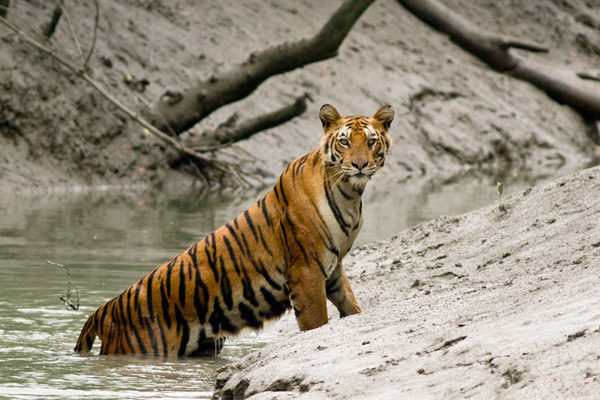
The extraordinary importance of the Bengal tiger begins with geography. The Sundarbans occupies the vast lower Ganges–Brahmaputra–Meghna delta, where fresh water, tidal seawater, sediment and land constantly interact. UNESCO describes the Sundarbans as the world’s largest mangrove forest and identifies it as the only mangrove habitat in the world inhabited by tigers. The Indian and Bangladeshi portions together form an enormous transboundary ecological landscape, although the conservation regimes on the two sides are administered separately. In the Indian Sundarbans, the tiger exists within a mosaic of mangrove woodland, creeks, beaches, mudflats and transitional habitats, making it one of the rare large terrestrial predators on Earth that has adapted to an ecosystem dominated by tides. UNESCO specifically notes that Sundarbans tigers have adapted to an almost amphibious existence and are capable of swimming long distances; they can also feed on prey associated with aquatic environments, including fish, crabs and water monitors. (UNESCO World Heritage Centre)

That environment has influenced the tiger itself. Scientific research on Sundarbans tigers has found morphological differences from mainland Bengal tigers, including smaller skull dimensions and smaller body size in the studied animals. Importantly, genetic analysis did not support treating Sundarbans tigers as a separate tiger subspecies; they remain Bengal tigers, Panthera tigris tigris. At the same time, researchers found sufficiently strong ecological and evolutionary differences to argue that the Sundarbans population should receive distinct conservation attention. The likely reasons include the unusual mangrove environment, relatively small-bodied prey, limited competition with other large carnivores and the energetic advantages of a somewhat smaller body in soft, muddy terrain. This distinction is one of the most fascinating aspects of the animal: it is not a different tiger species, but a tiger population that has been profoundly shaped by Bengal’s tidal wilderness. (PLOS)
A Life Written by the Tide
Few tiger habitats demand as much movement between land and water as the Sundarbans. Research in the Indian Sundarbans found that tigers crossed an average of five water channels wider than 30 metres each day, while channels wider than about 400 metres were crossed much less frequently. Their average daily movement was approximately 4.6 kilometres, although individual movement varied greatly, and tiger activity showed a pronounced peak during the morning period. Large channels also function as territorial boundaries, meaning that the waterways are not simply obstacles: they help structure how tigers move through the landscape, patrol territories and locate prey. This is one reason why a Sundarbans tiger is so different in behaviour from the popular image of a tiger moving through a continuous terrestrial forest. Here, water is part of the tiger’s geography. (PLOS)
The structure of the mangrove forest also influences where and how these animals hunt. Studies have found stronger signs of feeding and movement within mangrove woodland and transitional habitats, where vegetation provides concealment and stalking opportunities. In contrast, exposed beaches and very open areas offer less cover and lower prey availability. Tigers therefore exploit a landscape that may appear fragmented to humans but functions as an interconnected hunting territory for the animal. The muddy ground, dense vegetation, tidal channels and narrow islands create an environment where stealth and patience are often more important than the high-speed pursuit associated with popular images of big cats. (Cambridge University Press)
The Deer, the Boar and the Hunt
The Sundarbans does not offer the same abundance and variety of large ungulates found in many mainland tiger landscapes, and that has shaped the Bengal tiger’s hunting ecology. A major 2025 study of tiger prey in the wider Sundarbans found that spotted deer, or chital (Axis axis), had a particularly strong relationship with tiger abundance, while wild boar (Sus scrofa) formed another important component of the prey base. The study estimated mean densities of approximately 35.44 spotted deer and 15.75 wild boar per square kilometre in its surveyed areas and found a statistically significant positive relationship between spotted deer abundance and tiger abundance. These findings reinforce a fundamental truth of tiger conservation: protecting the tiger without protecting its prey cannot produce a stable population in the long term. (ScienceDirect)

The hunting behaviour of a Sundarbans tiger therefore follows the rhythm of its prey and habitat. Dense vegetation provides stalking cover, riverbanks offer travel corridors, and tidal channels determine how the animal moves from one part of its territory to another. The tiger can swim, navigate mud and use narrow strips of land between waterways, allowing it to exploit islands that would be inaccessible to many other large predators. UNESCO has documented that these tigers can also consume fish, crab and water monitor lizards, demonstrating the unusually flexible diet that helps them survive in a habitat where food resources differ substantially from those available in mainland forests. (UNESCO World Heritage Centre)
How Many Tigers Remain?
Population figures for the Sundarbans require careful interpretation because different monitoring exercises cover different areas and use different reporting stages. As of September 2026, the most recent authoritative nationally comparable estimate for the Indian Sundarbans is 101 tigers, from the All India Tiger Estimation 2022 exercise, whose detailed report was published in 2023. Wildlife Institute of India and the National Tiger Conservation Authority report an estimated density of about 4.27 tigers per 100 square kilometres for the Indian Sundarbans, with an estimated population of 101 individuals. The figure refers to the scientific estimation framework used by the national tiger assessment rather than a simple count of every animal seen. (Wildlife Trust of India)
There is also newer monitoring information that is important but should not be confused with a finalized new national estimate. The official Sundarban Tiger Reserve Annual Report 2024–25 states that 81 tigers were photo-captured within the Tiger Reserve and another 20 in adjoining South 24-Parganas, with one individual common to both areas; it reports a density estimate of 4.27 per 100 square kilometres and notes that the 2024–25 data were sent to the Wildlife Institute of India for further analysis. A separate demographic table in the same annual report lists 105 individually identified tigers for 2024–25, while explicitly noting that cubs are excluded under NTCA estimation guidance and that manual identification errors are possible. For that reason, the most defensible figure to use in a professional article is 101 as the latest published authoritative population estimate, while 2024–25 monitoring should be described as a newer survey dataset rather than as a finalized replacement estimate.
The significance of those numbers becomes clearer in a global context. India’s 2022 All India Tiger Estimation produced an average national estimate of 3,682 wild tigers, within a range of 3,167–3,925, making India the central stronghold for the species globally. The Indian Sundarbans therefore holds only a small fraction of India’s total tiger population, but its significance is disproportionately large because it represents the world’s unique mangrove-adapted tiger population. Saving these tigers means conserving not just numbers but an ecological adaptation that has developed within one of the planet’s most unusual environments. (Press Information Bureau)
From Royal Hunting to Conservation
The tiger’s present status becomes even more remarkable when its history is considered. During the nineteenth and early twentieth centuries, tigers in the Indian subcontinent were heavily hunted, while expanding agriculture, infrastructure and human settlement steadily reduced their habitat. At the beginning of the twentieth century, estimates placed India’s tiger population at tens of thousands, although those historical numbers are considered approximate. By 1972, the first systematic all-India tiger census produced a dramatically different picture: only 1,827 tigers were estimated to remain. Hunting was a major factor, but habitat destruction and wider human pressure were equally important parts of the decline. (National Tiger Conservation Authority)
India responded with a new conservation philosophy. The Wildlife (Protection) Act was enacted in 1972, followed by the launch of Project Tiger on 1 April 1973. The Sundarbans was one of the original nine Tiger Reserves selected when the programme began. That historical status matters: the Sundarbans was not added to India’s tiger conservation system as an afterthought; it was recognised from the very beginning as one of the landscapes essential to the survival of the species. Over the decades, Project Tiger evolved from protected-area establishment into a much broader system involving habitat management, scientific monitoring, anti-poaching protection, conflict mitigation, research and community-oriented programmes. (Press Information Bureau)

The conservation story of the Sundarbans is therefore not merely a story about saving an animal from hunters. It is a story about changing the relationship between people, protected landscapes and wildlife. Modern tiger conservation combines camera trapping, spatially explicit population estimation, habitat monitoring, prey assessment and field protection. NTCA describes the tiger as an “umbrella species,” meaning that maintaining viable tiger populations requires protection of the broader habitat and prey community on which many other species also depend. In this sense, the tiger has become a vehicle for conserving an entire ecological system rather than a single charismatic animal. (National Tiger Conservation Authority)
Bengal’s Tiger Is Also Bengal’s Cultural Memory
For the people of Bengal, the tiger occupies a place that goes far beyond wildlife biology. In the Sundarbans, the animal has become deeply woven into folklore, ritual, music and the lived experience of communities that depend on the forest. UNESCO’s documentation of the region’s living heritage highlights Bonbibir Pala, Bhatiyali and other cultural traditions in which forests, waterways, storms and tiger encounters appear together. The folk tradition of Bonbibi and Dakshin Rai reflects a world in which the boundary between human society and wilderness has historically been intimate and dangerous. (UNESCO)
For generations, people entering the forest to fish, collect honey or gather forest resources have lived with the possibility of encountering a tiger. Ethnographic research from the Indian Sundarbans documents the cultural importance of Bonbibi among both Hindu and Muslim communities and the traditional association of Dakshin Rai with the tiger. These traditions do not represent zoological explanations of tiger behaviour; they are cultural systems developed by communities living in an environment where survival has always depended on negotiating the boundary between human life and the forest. The tiger consequently became both a physical presence and a cultural symbol—a creature that represents the power, danger and unpredictability of the Sundarbans itself. (PubMed Central (PMC))
This is part of what makes the phrase “Royal Bengal Tiger” so culturally powerful. “Royal” is not a scientific measurement of superiority over other tiger populations; it is an expression of majesty that has accumulated through language, literature, art, colonial-era representations, hunting history and modern conservation culture. “Bengal” then anchors that symbolism geographically and historically. The result is a name that has become globally recognisable even though its scientific identity is simply that of the Bengal tiger, Panthera tigris tigris. The name survives because the animal has become inseparable from the cultural imagination of Bengal. (Banglapedia)

A Tiger That Shapes an Ecosystem
The Royal Bengal Tiger matters ecologically because it sits at the top of the food web. Its survival depends on healthy prey populations, functioning wetlands, stable vegetation and sufficient territory; its presence in turn reflects the ecological condition of that landscape. NTCA explicitly describes the tiger as an umbrella species whose conservation supports co-predators, prey species, forests and broader ecological viability. In the Sundarbans, protecting tiger habitat consequently means protecting a complex network of deer, wild boar, monkeys, reptiles, birds, fish, mangroves and tidal waterways. (National Tiger Conservation Authority)
The importance of the tiger is also inseparable from the importance of the mangrove forest itself. UNESCO identifies the Sundarbans as a globally important natural system that functions as a storm barrier, shoreline stabiliser, nutrient and sediment trap and nursery for aquatic organisms. Mangroves also store carbon and help buffer coastal communities from extreme weather. Thus, the fate of the tiger and the fate of the Sundarbans are closely connected: when the ecological system deteriorates, the tiger loses habitat and prey; when tiger habitat is effectively protected, many other components of the ecosystem benefit as well. (UNESCO World Heritage Centre)
Climate Change: The Threat Coming with the Tide
Perhaps the greatest long-term challenge facing the Sundarbans tiger is climate change. The region is exceptionally vulnerable because its landscape is extremely low-lying and governed by tides, erosion, sedimentation and cyclones. The Government of India’s climate assessment for West Bengal identifies sea-level rise, changing precipitation patterns and increasing cyclone intensity as major climate concerns for the Sundarbans. The West Bengal climate dashboard currently cites a tide-gauge-observed sea-level rise of approximately 5.7 millimetres per year at Diamond Harbour, while also noting increasing coastal vulnerability to storm surge, salinity and erosion. These figures are regional indicators rather than a measurement of tiger habitat alone, but they demonstrate the environmental pressures acting on the delta. (NAPCC Dashboard)

Scientific studies have already documented changes within the Indian Sundarbans. Research examining the effects of major cyclones including Fani, Bulbul, Amphan and Yaas found increasing tidal-water salinity between 2017 and 2021, along with significant changes in mangrove vegetation and soil properties. The study reported a 31 percent increase in soil salinity and a 46 percent reduction in the measured soil organic blue-carbon pool in the study system, with several salinity-sensitive mangrove species disappearing locally from sampled areas. Such changes matter to tigers indirectly as well as directly because the tiger depends on the structure and productivity of the entire mangrove ecosystem that supports its prey. (PubMed)
Climate modelling also suggests how serious the long-term risk could become. One influential study modelled future tiger habitat under IPCC climate scenarios in the Bangladesh portion of the Sundarbans and projected a dramatic decline in suitable habitat, with no suitable habitat remaining in that model by 2070 under the scenarios examined. This should not be interpreted as a precise prediction that every part of the Indian Sundarbans will lose all tiger habitat by 2070; the study concerned the Bangladesh Sundarbans and modelled scenarios carry uncertainty. What it demonstrates clearly is that climate change and sea-level rise can become landscape-scale threats to tiger persistence in a low-lying mangrove ecosystem. (ScienceDirect)
When Tigers and People Share the Same Frontier
The Sundarbans is unusual because millions of people live around the forest while depending on fisheries, honey, forest products, agriculture and other natural resources. UNESCO reports that around 4.5 million people live in the Indian Sundarbans and that communities living near the forest can come into close contact with wildlife. Human–tiger conflict therefore cannot be discussed simply as a problem of “wild animals entering human territory”; much of the landscape consists of former forest land now occupied by villages, agricultural fields, embankments and working communities. The challenge is to create a landscape in which both people and tigers can survive. (UNESCO World Heritage Centre)

Modern conservation programmes have increasingly emphasised coexistence and prevention rather than confrontation. UNESCO has documented participatory management measures, local informer networks, eco-development programmes and strategies for reducing tiger incursions into villages. WWF India and the Forest Department have also used tiger fencing along village fringes as one conflict-mitigation measure; UNESCO reported that after fencing was installed along selected village boundaries in 2018, no tigers strayed into those particular human habitation areas during the period described in its report. Such approaches illustrate the broader principle that conservation becomes more durable when the people living beside wildlife are treated as partners rather than obstacles. (UNESCO World Heritage Centre)
The current Sundarban Tiger Reserve itself provides evidence of this participatory approach. Its 2024–25 annual report records 26 Joint Forest Management Committees covering 38 revenue villages, with all 26 committees including women as executive-committee members. It also records 173 self-help groups and reports that the Forest Department’s share of ecotourism revenue distributed through JFMC-linked development mechanisms amounted to more than ₹1.73 crore in 2024–25. These programmes do not solve every social or ecological problem, but they demonstrate how conservation, local institutions and economic participation can be connected within the landscape.
The Quiet War Against Poaching
Poaching remains one of the classic threats facing tiger conservation because the illegal wildlife trade can target both tigers themselves and their prey. On the Indian side of the Sundarbans, the recent protection record is encouraging: the Sundarban Tiger Reserve’s 2024–25 annual report records no poaching cases for tigers or other wildlife in the reserve during each of the five financial years from 2020–21 through 2024–25. It also records an extensive network of land-based and floating anti-poaching camps and regular patrol operations. This is an important conservation achievement, but zero recorded cases in a particular management area and period should not be interpreted to mean that wildlife crime is no longer a threat; continued surveillance, intelligence, law enforcement and prey protection remain essential.

Why Saving the Royal Bengal Tiger Matters
To protect the Royal Bengal Tiger of the Sundarbans is to protect far more than a celebrated predator. It means preserving one of the last great mangrove wildernesses on Earth, maintaining prey populations, protecting tidal wetlands and mangrove forests, supporting ecological processes and sustaining a landscape on which millions of people depend. It also means preserving a living cultural connection that appears in songs, stories, rituals and the daily vocabulary of communities that have shared the forest with this powerful animal for generations. The UNESCO World Heritage designation of the Sundarbans reflects precisely this combination of ecological uniqueness and global importance. (UNESCO)
For the wider world, the tiger is a symbol of what large-scale conservation can achieve when science, law, habitat protection and public commitment work together. India’s tiger population has risen dramatically since the crisis of the early 1970s, and the Sundarbans remains one of the most distinctive landscapes within that recovery story. Yet the future cannot be guaranteed by numbers alone. A population can survive only when its habitat remains functional, its prey remains abundant, its movements remain possible, its threats are controlled and the communities around it have a meaningful place in conservation. (Press Information Bureau)
The Royal Bengal Tiger is therefore best understood not simply as “the tiger of Bengal,” but as a living expression of Bengal’s relationship with land, river, forest and sea. Its orange coat moving silently through the mangrove shadows, its footprints disappearing beneath tidal water, its territory divided by creeks and its presence woven into the folklore of the people around it have made it one of the most recognisable animals on the planet. The name “Royal Bengal Tiger” carries history, but the animal itself carries something even more valuable: the ecological memory of a landscape that has survived centuries of human pressure, and a warning that its survival will always depend on the survival of the Sundarbans itself. In that sense, the tiger is not merely a jewel of Bengal; it is one of the clearest living symbols of why Bengal’s natural heritage matters to the entire world. (UNESCO)


