

Bonedi Bari - Kolkata
We make things that work better and last longer. Our products solve real problems with clean design and honest materials.
Step into the world of Bonedi Kolkata, where ancestral houses, forgotten histories and centuries-old Durga Puja traditions preserve the cultural memory of Bengal. From Barisha and Shobhabazar to the living heritage of today, discover how the old houses of Kolkata became guardians of one of Bengal’s greatest traditions.
Calcutta Watch Company | Kripanti Maity
The Ancestral Houses, Living Traditions and the Durga Puja That Became a World Heritage of Bengal
There is a particular kind of silence that belongs to an old Bengali house. It lives beneath ceilings darkened by time, behind tall wooden shutters, around long courtyards where generations once gathered, and beneath the arches of a thakur dalan where the autumn light seems to fall differently during Durga Puja. In such houses, the festival is rarely something that is created anew every year. It is inherited. A ritual survives because someone in the previous generation remembered it. A particular style of idol continues because an ancestor established it. A recipe appears on a particular day because generations before followed the same practice. The architecture, the rituals, the food, the music, the people and even the silence of the house become part of one continuous memory. This is the world of the Bonedi Bari, one of the most distinctive expressions of Bengal's social and cultural heritage.
WHAT DOES “BONEDI BARI” REALLY MEAN?
The expression Bonedi Bari does not describe a legally recognised class, caste or official title. It is a cultural and social expression used in Bengal to describe old, established and socially prominent families whose histories are associated with lineage, property, influence, wealth and cultural standing. The word Bonedi is commonly connected with the Bengali term Buniyadi, carrying the sense of something foundational, established or deeply rooted, while Bari simply means house or home. Over generations, Bonedi Bari came to signify not merely a large or wealthy residence, but an ancestral household whose identity had become established through time. That distinction matters because wealth alone never automatically made a family Bonedi. The idea traditionally involved something deeper: an old lineage, a recognised social position, accumulated property or influence, cultural patronage and a family history that had become part of the larger story of Bengal. Many such families were zamindars or landholders, while others built their fortunes through trade, banking, shipping, money-lending, administration, business and commercial relationships associated with the expanding colonial economy. During the eighteenth and nineteenth centuries, many prosperous families established increasingly elaborate homes in Calcutta, particularly across the northern and central parts of the growing city, and within those homes Durga Puja gradually became one of the greatest expressions of family identity.
BEFORE CALCUTTA BECAME KOLKATA
The history of Bonedi Kolkata begins before Kolkata became the great colonial metropolis that the modern world recognises. The region was once made up of settlements including Sutanuti, Govindapur and Kalikata, while the Sabarna Roy Chowdhury family, one of Bengal's historically important landed families, held zamindari rights over these areas. In 1698, the East India Company acquired the zamindari rights of Sutanuti, Govindapur and Kalikata from the Sabarna Roy Chowdhury family for Rs 1,300. Those settlements would gradually develop into the foundation of modern Calcutta. The significance of this history is profound because it reminds us that Kolkata was not simply created by the British. The city developed through a complicated interaction between older Bengali landed society, commercial expansion, colonial administration, migration, trade, property and the enormous economic transformation taking place around the Hooghly River. The old families who later became identified with the Bonedi tradition therefore belong to a story that predates the mature colonial city itself.

1610 — BARISHA AND ONE OF KOLKATA'S OLDEST FAMILY PUJAS
Among the oldest Durga Puja traditions associated with present-day Kolkata is the Puja of the Sabarna Roy Chowdhury family at Barisha. Family and heritage sources traditionally date the beginning of their Durga Puja to 1610. Whether that date is treated as a precise historical starting point or as a family tradition preserved through generations, its significance remains extraordinary. It places the Barisha tradition more than a century before Calcutta emerged as the major colonial city of the eighteenth century. The Sabarna family therefore represents an important chapter in Bengal's cultural history in which Durga worship existed within an established landed society long before the great mansions of colonial Calcutta reached their later prominence. In that sense, the story of Bonedi Puja does not begin with British Calcutta. It begins with Bengal's own old families and their relationship with land, ritual and community.
THE RISE OF THE BONEDI ELITE
As Calcutta expanded through the eighteenth and nineteenth centuries, a new urban elite gradually emerged. Some families belonged to older landed lineages, while others accumulated enormous wealth through trade, banking, shipping, revenue administration, money-lending, business and other commercial activities connected with the growing colonial economy. The Hooghly had become one of the great commercial arteries of eastern India, European trading companies were expanding their presence, markets were growing, administrative structures were becoming more centralised and new commercial networks were developing around the city. Alongside this transformation emerged a powerful Bengali elite with wealth, property, education, influence and cultural ambition. These families built mansions, acquired estates, patronised musicians and craftsmen, entertained guests, supported religious institutions and increasingly used festivals as expressions of family identity and social presence. Among all these occasions, Durga Puja became one of the most important because it could simultaneously express faith, family, prosperity, hospitality and cultural prestige.
1757 — THE SHOBHABAZAR RAJBARI TRADITION
Few names are more closely associated with Kolkata's Bonedi Durga Puja tradition than Raja Nabakrishna Deb of Shobhabazar. The Shobhabazar Rajbari Puja is traditionally dated to 1757, the same year as the Battle of Plassey, and it became famous for its scale, social importance and association with the emerging colonial elite. The popular story says that Robert Clive attended the celebration and that the Puja was organised as part of the festivities surrounding the political transformation that followed Plassey. Yet historical scrutiny has shown that several details of this famous narrative are difficult to verify from contemporary documentary evidence, and the exact circumstances of the earliest celebration should therefore be distinguished from later family tradition and popular storytelling. What is historically important beyond the legend is the larger transformation taking place in eighteenth-century Calcutta. Household Durga Puja had become a place where religion, wealth, hospitality, music, food and social power came together. The courtyard was no longer merely a sacred space; it was also a stage upon which the emerging elite of Calcutta presented itself.

THE THAKUR DALAN
At the heart of many Bonedi Bari traditions stands the thakur dalan, an architectural courtyard or ceremonial space facing the place where the Durga idol is installed. Yet its importance extends far beyond architecture. The thakur dalan created a space in which the household, priests, musicians, craftsmen, guests and members of the wider community could gather around a shared ritual. The house became an extension of the Puja, and the Puja became an extension of the house's identity. Its columns, balconies, arches, lamps, wooden shutters and courtyards became part of the visual language of the festival. This is one of the reasons a Bonedi Puja feels so different from a contemporary neighbourhood Puja surrounded by temporary structures. In a Bonedi Bari, the architecture itself is part of the heritage. The old house does not simply provide a background for the festival; it is one of the central characters in the story.
THE ART OF THE BONEDI IDOL
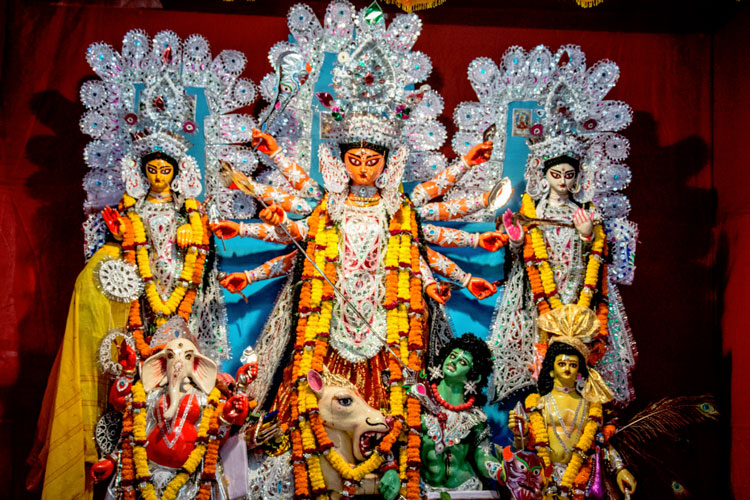
One of the most fascinating features of Bonedi Puja traditions is the extraordinary variety of idol styles and ritual practices that have survived within individual families. Many old houses preserve distinctive approaches to the image of Durga, including the traditional ekchala arrangement in which Durga and her children are presented together within a single large composition. Families may retain particular forms of decoration, facial design, ornaments, colours, rituals, offerings or ceremonial practices that are not necessarily shared by other households. These differences are historically valuable because they demonstrate that there has never been one completely uniform version of Bengali Durga Puja. Instead, there are hundreds of local memories contained within the larger festival. Every ancestral house may have its own interpretation, its own ritual rhythm and its own relationship with the goddess.
1759 — FROM FAMILY PUJA TO COMMUNITY PUJA
The history of Durga Puja did not remain confined to wealthy households. One important development was the emergence of the barowari tradition, and Guptipara in Hooghly is traditionally associated with a community celebration in 1759 in which twelve friends pooled resources to organise a collective Puja. The details of this origin story have been retold in different ways over time, but the broader development is important. The goddess was gradually moving beyond the enclosed space of a single household, and the community itself could become the patron of the festival. This marked a major cultural shift, because it opened the way for the later public and sarbojanin traditions that would eventually define the modern urban Durga Puja.
1793 — THE PERMANENT SETTLEMENT AND THE LANDHOLDING ELITE
The Permanent Settlement introduced in Bengal in 1793 under the East India Company further reshaped the structure of land revenue and strengthened the legal position of many zamindars as hereditary landholders responsible for revenue payments. The system did not create every wealthy Bengali family, and not every Bonedi family emerged through zamindari, but it became one of the major structures through which property, wealth and social influence were consolidated among sections of the Bengali landed elite. During the nineteenth century, that elite became increasingly visible in the architecture and cultural life of Calcutta. Their mansions expanded, their ceremonial spaces became more elaborate, and their festivals became increasingly important markers of identity and social prestige.
THE GOLDEN AGE OF THE BONEDI BARI
The nineteenth century witnessed the great flowering of Kolkata's old aristocratic houses. Families built imposing residences with large courtyards, high columns, ornamental balconies, ceremonial rooms, elaborate entrances and architectural influences that blended Bengali traditions with elements introduced through colonial contact. These houses were not simply places to live. They represented status, lineage and cultural authority. They hosted music, theatre, religious ceremonies and social gatherings; they employed craftsmen and artisans; they created networks of patronage; and every year, Durga Puja transformed these private residences into extraordinary cultural spaces. Priests, drummers, musicians, cooks, artisans, relatives and guests came together, food was prepared on a large scale, rituals were repeated according to inherited patterns and the ancestral house became alive once again. The festival was therefore both intimate and spectacular: deeply personal to the family, yet socially visible to the city around it.
1859 — A VISUAL RECORD OF NINETEENTH-CENTURY DURGA PUJA
The nineteenth century also left behind rare visual records of Kolkata's Durga Puja. Among the most notable are works associated with Alexis Soltykoff depicting the Festival of the Goddess Durga at Calcutta in 1859. Such representations are valuable because they provide glimpses into the visual and social world surrounding the festival during the colonial period. They remind us that the extraordinary public character of Durga Puja was not a modern invention. By the middle of the nineteenth century, the festival had already become a sophisticated cultural institution combining religious ceremony, architecture, hospitality, music, art and social interaction.
1905 — DURGA AS THE MOTHERLAND
The Partition of Bengal in 1905 added another powerful dimension to the cultural meaning of Durga. During the Swadeshi movement, the image of the mother became increasingly connected with the idea of the motherland. The goddess could therefore be interpreted not only through religious devotion but also through ideas of Bengal, cultural identity, resistance and national consciousness. The older religious symbolism did not disappear; instead, new meanings were added to it. This capacity to absorb changing cultural ideas without losing older traditions is one of the reasons Durga Puja has remained so resilient. The festival has repeatedly changed its social meaning while maintaining the ritual core that makes it recognisably Durga Puja.
1910 — THE RISE OF MODERN COMMUNITY PUJA IN CALCUTTA
By the beginning of the twentieth century, Durga Puja was increasingly becoming a public festival. A significant milestone came in 1910 with the Bhowanipore Puja at Balaram Bose Ghat, often identified in historical accounts as one of the early organised community Pujas of Calcutta. The emergence of such celebrations transformed the geography of the festival. Durga was no longer worshipped only inside ancestral mansions. She could now belong to an entire neighbourhood. This movement toward the modern sarbojanin tradition fundamentally changed Kolkata's relationship with the festival and helped establish the citywide cultural phenomenon that would emerge during the twentieth century.

BONEDI AND SARBOJANIN — TWO HISTORIES, ONE CITY
Two great traditions now exist side by side in Kolkata. The Bonedi Puja is rooted in family inheritance, ancestral space and ritual continuity, while the Sarbojanin Puja is rooted in collective participation, neighbourhood identity and public celebration. The Bonedi Bari preserves the memory of an older household culture, while the community Puja expresses the identity of the modern city. One is inherited through generations of a family; the other is created collectively by a neighbourhood or organisation. Yet they are not separate histories. They are two chapters of the same cultural evolution. The old aristocratic courtyard helped establish the cultural prestige of Durga Puja, while the community tradition eventually transformed that prestige into a festival in which the entire city could participate.
WHAT HAPPENED TO THE BONEDI FAMILIES?
The world that created Kolkata's great Bonedi houses did not remain unchanged. The end of colonial rule transformed the political and economic order. The abolition of zamindari altered the financial position of many old landed families. Partition caused migration and the loss of ancestral property. Large estates were divided between branches, property values changed, maintenance costs increased and some enormous houses became increasingly difficult to preserve. Some families became less wealthy, some moved away and some ancestral structures deteriorated. Yet many family Pujas survived. This is perhaps the most beautiful part of the story. The survival of the tradition did not depend entirely on the survival of the wealth that created it. A family could lose its estate and preserve its Puja. A mansion could decline while its ritual continued. A tradition could survive even after the social world that originally created it had disappeared. That is why Bonedi heritage is not simply about old buildings. It is about continuity.
THE BONEDI FAMILIES TODAY
Today, the descendants of Kolkata's old families do not form one single economic or social category. Some remain affluent, some are business owners, some are professionals, some are involved in cultural work, some live outside Kolkata or India, and some live in considerably more modest circumstances than their ancestors. Yet many continue to return every autumn to the same family rituals. Traditional food may still be prepared according to inherited recipes. Particular forms of worship may still be followed. Distinctive idol styles may still be recreated. In some families, traditions have been reconstructed after migration from former ancestral homes, while in others the rituals have been adapted to changed economic and physical circumstances. The house may change, the family may change and the city may change, but the Puja can remain.
WHY DURGA PUJA IS SO IMPORTANT TO BENGAL
Durga Puja is much more than a religious festival in West Bengal. It is at once a religious celebration, a cultural festival, an artistic movement, an economic ecosystem, a social reunion and an annual transformation of the urban landscape. Sculptors create the idols, artisans construct temporary spaces, designers develop visual concepts, drummers provide the soundscape, priests conduct rituals, cooks prepare traditional food, and countless workers in transport, decoration, electricity, floristry, photography, tailoring and other trades contribute to the festival. The celebration therefore connects an enormous number of people and professions. It is not simply something that the public watches. It is something that thousands of people collectively create.
THE EMOTIONAL HEART OF THE FESTIVAL
At its emotional centre lies the idea of Durga's return. In Bengali tradition, Durga is often imagined as a daughter returning to her maternal home during the autumn festival. That idea of homecoming is deeply woven into Bengali cultural memory. The goddess returns home, families return home, friends return home and people living in distant cities or countries often return to Kolkata during the Puja season. The festival therefore combines devotion with memory. It is one of the reasons the celebration can feel deeply personal even to those who are not directly connected to a particular temple or household. Durga Puja becomes a season in which the city itself seems to remember the idea of home.

WHY KOLKATA'S DURGA PUJA BECAME GLOBALLY RECOGNISED
Kolkata's Durga Puja became globally recognised because it developed into something much larger than a ritual performed inside a temple or ancestral home. It became a form of public art. The idol became sculpture, the pandal became architecture, the neighbourhood became an exhibition space, music became part of the city's atmosphere and traditional craftsmanship began interacting with contemporary design. Historical family traditions existed beside modern artistic experimentation, while thousands and eventually millions of visitors moved through different parts of the city to experience the festival. The result was one of the world's most remarkable recurring urban cultural spectacles, yet beneath the contemporary scale remained the simple ritual act of welcoming the goddess.
2021 — UNESCO RECOGNITION
In December 2021, UNESCO inscribed Durga Puja in Kolkata on the Representative List of the Intangible Cultural Heritage of Humanity. This distinction is important because Durga Puja in Kolkata is not a UNESCO World Heritage Site in the same category as a monument, building or historic city. It was recognised as Intangible Cultural Heritage, meaning that UNESCO was acknowledging a living tradition carried through people, practices, skills, rituals, craftsmanship and collective participation. UNESCO's documentation highlights the festival's combination of religious worship, clay sculpture, large-scale installations, Bengali drumming, performing arts, craftsmanship and public participation, while also recognising the knowledge transmitted through families, artists, priests, artisans, community organisers and other practitioners. The inscription therefore did not freeze Kolkata's Durga Puja in one historical form. Instead, it recognised the living cultural tradition that continues to evolve while retaining its identity.
WHY KOLKATA BECAME THE CULTURAL HEART OF A GLOBAL FESTIVAL
Durga Puja is not confined to Kolkata or even to West Bengal. It is celebrated throughout India and by Bengali communities around the world. Yet Kolkata occupies a special place in that global network because the city developed an extraordinary combination of historic family traditions, artisan communities, public Pujas, cultural institutions, creative industries, neighbourhood associations and a highly participatory urban environment. The city transformed the festival into a vast form of collective cultural production. A pandal can become architecture, an idol can become sculpture, a street can become a gallery, a neighbourhood can become a theatre and a family ritual can become a piece of public memory. UNESCO's recognition reflects this ecosystem of participation rather than simply the visual grandeur of the celebration.
A CENTURY OF MEMORY
The history of Bonedi Kolkata can be understood through a remarkable sequence of dates. The Barisha family tradition is traditionally traced to 1610. In 1698, the East India Company acquired the zamindari rights of Sutanuti, Govindapur and Kalikata from the Sabarna Roy Chowdhury family for Rs 1,300. The Shobhabazar Rajbari Puja is traditionally dated to 1757. The community tradition associated with Guptipara is dated to 1759. The Permanent Settlement transformed Bengal's landholding structure in 1793. The nineteenth century saw the flourishing of the great aristocratic houses and their elaborate household festivals. The Partition of Bengal in 1905 gave Durga new nationalist symbolism, and by 1910 early organised community Pujas were emerging in Calcutta. Across the twentieth century, the decline of zamindari, migration, Partition, economic change and urban redevelopment transformed the old families, yet many ancestral Pujas survived. Finally, in December 2021, Durga Puja in Kolkata received UNESCO recognition as Intangible Cultural Heritage of Humanity, placing the living tradition of Bengal within a global cultural framework.

THE MEANING OF BONEDI KOLKATA TODAY
The old houses of Kolkata are often photographed for their weathered walls, ornate balconies, pillars, courtyards and faded grandeur. Yet their greatest value is not architectural alone. A wall can be repaired, a roof can be reconstructed and a façade can be restored, but memory is much harder to recreate. That is what the surviving Bonedi Pujas carry. They remember the families who helped shape the early social world of Calcutta, the craftsmen who returned year after year to create the idols, the recipes and rituals that rarely exist in official records, and the networks of people who transformed religious worship into a major cultural institution. They also preserve a version of Kolkata that could easily disappear from physical memory if these traditions were allowed to vanish.
The Bonedi Bari therefore remains important in the twenty-first century not because every old family is still wealthy, and not because every ancestral house remains untouched, but because these traditions demonstrate that heritage is not simply something that can be placed behind glass. Heritage can be practiced. It can be cooked. It can be sung. It can be built. It can be inherited and passed on. The continued existence of a family Puja inside a changing city is itself an act of historical preservation.
THE FINAL STORY
The history of Kolkata's Bonedi Bari is ultimately the history of a city learning how to remember itself. It begins with land and lineage, grows through trade, wealth and colonial transformation, takes architectural form in the great houses of Calcutta, finds powerful expression in Durga Puja, expands from private courtyards into public streets and eventually becomes part of a cultural tradition recognised on the world stage. The old houses of Kolkata are therefore not merely remnants of a vanished aristocratic age. They are living archives of Bengal.
That is what makes Bonedi Kolkata so extraordinary. The old mansion may no longer possess the wealth of the eighteenth century. The family may have scattered across different cities and countries. The walls may carry the marks of age, and the neighbourhood surrounding the house may look completely different from the world its founders knew. Yet when autumn arrives, the courtyard is cleaned, the ritual space is prepared, the idol is installed, the drums begin to sound and generations gather once again, the house briefly becomes what it has always been.
Not merely a residence, but a keeper of memory.
And perhaps that is why Durga Puja feels so deeply connected with Kolkata. The festival is not only about the arrival of the goddess. It is about the return of memory, the return of family, the return of community and the return of a city to something older than itself. Every autumn, beneath the ancient columns of a Bonedi Bari and across the streets of modern Kolkata, the past and present meet once again.
The city does not simply celebrate a festival.
For a few unforgettable days, Kolkata remembers who it was.


