

Calcutta Tram: The Story of the Vehicle That Carried a City Through Time
We make things that work better and last longer. Our products solve real problems with clean design and honest materials.
For more than 150 years, the Calcutta Tram has travelled through the changing streets and history of Kolkata. From the first horse-drawn journey in 1873 to the electric tramways that became an enduring symbol of the city, discover the extraordinary story of a vehicle that carried generations of people—and eventually became heritage on wheels.
Calcutta Watch Company | Kripanti Maity
There are vehicles that take people from one place to another, and then there are vehicles that eventually become part of the identity of the place itself. The Calcutta Tram belongs to the second category. For generations, its slow movement, steel wheels, overhead electric wires and unmistakable wooden or steel-bodied carriages became inseparable from the visual memory of Kolkata. Long before the city was filled with flyovers, metro corridors, app-based taxis and endless streams of motor vehicles, the tram was already moving through its streets. It passed old colonial buildings, markets, theatres, business districts, residential neighbourhoods and historic crossroads. It carried office workers, students, families and generations of ordinary citizens, but over time it became something more than public transport. The tram became a moving witness to the changing history of Calcutta itself.
Today, when people imagine old Calcutta, they often imagine several familiar images together: yellow taxis moving through busy streets, hand-pulled rickshaws, colonial architecture, the Hooghly River, old bookshops, crowded markets and, somewhere between them, a tram quietly travelling along its rails. Its speed may have seemed slow in comparison with the modern city, but perhaps that was also part of its character. The tram did not rush through Kolkata. It appeared to move with the city, observing it, surviving it and becoming a part of its collective memory. The official history of the Calcutta Tramways traces the first tram journey in the city to 24 February 1873, when a horse-drawn tram ran between Sealdah and Armenian Ghat over a distance of approximately 3.9 kilometres.
Before Electricity, There Were Horses
The story of the Calcutta Tram did not begin with the familiar electric carriage that later came to define the city. Its earliest chapter belonged to horses. In the nineteenth century, Calcutta was growing rapidly as an important commercial and administrative centre. The movement of people and goods was becoming increasingly complex, and the idea of a rail-guided urban transport system began to emerge as a practical solution. The first horse-drawn tram ran from Sealdah to Armenian Ghat on 24 February 1873, creating an entirely new visual experience on the streets of the city. For the people of Calcutta, the sight of a carriage moving along fixed rails was more than another form of transport. It represented the arrival of a new urban age.
That first experiment, however, did not continue uninterrupted. According to the official timeline of the Calcutta Tramways system, the service was discontinued later in the same year, on 20 November 1873. But the idea had already been planted. In November 1880, tram services returned, once again using horse-drawn vehicles on the route connecting Sealdah, Bowbazar, Dalhousie and Armenian Ghat. The following period would establish the foundations of the organised tram system that would eventually become one of the most distinctive features of Calcutta's transport history.
The horse-drawn tram also reminds us how different the city once was. Before the roar of engines became the dominant sound of urban transport, animals, carriages, pedestrians and early forms of mechanised mobility shared the streets. The tram rails represented something new, but the vehicle moving upon them still belonged to an older world. A horse pulled the carriage, while the rails controlled its path. It was a fascinating combination of traditional power and industrial infrastructure.
In many ways, the tram's earliest story reflected the story of Calcutta itself: a city constantly changing, adopting new technologies while carrying traces of earlier generations forward.

The Arrival of Steam and the Search for a Faster City
As the city continued to expand, the limitations of horse-drawn transport became increasingly apparent. Horses had limits of strength, endurance and speed, while a rapidly growing urban system required greater capacity. The next stage in the evolution of Calcutta's tramways came with steam-powered traction. The official Calcutta Tramways timeline records the introduction of steam engine-driven trams in 1882, marking another significant transformation in the city's public transport system.
Steam represented the industrial age in motion. A city that had once watched horses pull tram carriages was now beginning to experiment with mechanical power. Yet steam-powered trams were not destined to become the defining image of Calcutta. Something even more revolutionary was approaching—electricity.
The transition from horses to steam and eventually to electric power tells an extraordinary story about the speed of technological change during the nineteenth and early twentieth centuries. Within only a few decades, urban transport was moving through entirely different sources of power. Each transformation changed not only the way the tram operated but also the visual language of the city. Horses disappeared from the front of the vehicle. Steam engines introduced mechanical power. Then, above the streets, a new web of electric wires began to appear.
The future was arriving.
And Calcutta was preparing to run on electricity.
1902: When Calcutta Entered the Electric Age
The most defining chapter in the history of the Calcutta Tram arrived in 1902, when electric tram operations began to shape the system that would become one of the city's greatest heritage symbols. The official historical material of the Calcutta Tramways records the introduction of electricity-powered tram services in the city at the beginning of the twentieth century, while widely documented historical accounts describe Calcutta as the first city in Asia to introduce an electric tram system.
This was an extraordinary moment. Electricity was transforming cities around the world, changing industry, communication, lighting and transport. In Calcutta, it transformed the tram from a carriage of the nineteenth century into a vehicle of the modern age. The horse was gone. Steam was no longer the future. Now the tram received power from overhead electrical infrastructure and travelled through the streets with a new kind of mechanical rhythm.
For the city, the electric tram was more than a technological upgrade. It represented modernity. It showed that Calcutta was connected with the global transformation taking place in major urban centres. The city was becoming faster, more interconnected and increasingly dependent on new forms of engineering.
Yet even after electrification, the tram retained a unique personality. It was modern for its time, but it never lost its human scale. Unlike a massive railway system, the tram moved directly through the streets. People could see it closely. They could hear it approaching. They could watch it stop at familiar points in the neighbourhood. It belonged to the city at ground level.
That relationship between the tram and the street would eventually become one of the reasons why it remained so emotionally connected with Kolkata.

The Rails Became Part of the Streets
A railway usually creates a separate world. Stations, platforms, bridges and railway corridors establish a boundary between the train and the city around it. The Calcutta Tram was different. Its tracks became part of the street itself. Pedestrians crossed them. Cars moved beside them. Shops opened along them. Markets expanded around them. Entire neighbourhoods developed their own memories of hearing the tram's bell and watching the carriage slowly appear around a corner.
The tram did not take people away from the city.
It travelled through the middle of it.
This made the Calcutta Tram one of the most visually distinctive forms of urban transport in India. The rails often appeared almost like lines drawn directly into the geography of the city, creating routes that connected historic districts and everyday life. A tram could move past grand architecture one moment and through a crowded commercial street the next. It could carry a passenger through different layers of Kolkata's social and cultural landscape without ever leaving the street.
This was the real beauty of the tram.
It was public transport, but it was also part of the scenery.
The streets changed around it.
Buildings were demolished and rebuilt.
Businesses opened and closed.
Generations came and went.
But the tram continued following the same fundamental principle: two rails, a carriage and a journey through the city.
From Calcutta to Howrah: A City Expands Across the River
The history of the tram was never limited entirely to one side of the Hooghly. The system eventually expanded and connected with Howrah, reflecting the growing relationship between the two great urban centres separated by the river. The official Calcutta Tramways timeline records electric tram services in Howrah from 1905, while the system was later linked more extensively across the urban region. By 1943, official records noted a total track length of approximately 68 kilometres across Kolkata and Howrah.
This expansion demonstrates how important tram transport had become to the wider metropolitan region. The tram was no longer an experimental vehicle running along a limited route. It had become part of the daily infrastructure of an enormous and growing city.
By the middle of the twentieth century, the system had entered one of its strongest periods. The official timeline records that by 1960, the tram fleet had reached 450 tram cars, while the network itself had developed across an extensive range of routes.
Imagine the Calcutta of that era.
The city was moving through a period of enormous social and political change. India had gained independence. New generations were entering offices, universities and industries. Roads were becoming increasingly busy. Yet the tram remained a familiar part of everyday life. For countless people, it was not a tourist attraction or a heritage experience. It was simply how one travelled.
That is perhaps what makes its history so powerful today.
The tram became heritage only after first being ordinary.
It became iconic only because generations of people used it without necessarily imagining that one day it would become a symbol of a disappearing era.
A Vehicle That Witnessed History
The Calcutta Tram travelled through some of the most dramatic periods in the history of the city and the subcontinent. Its carriages operated through the final decades of British rule, the freedom movement, the Second World War, independence and the transformation of Calcutta into modern Kolkata. The official Calcutta Tramways history describes the tram as a kind of witness to the city's historical journey, surviving different phases of change and continuing to move through generations of urban transformation.
This idea of the tram as a witness is especially important for a heritage story.
A building can preserve history because it remains standing in one place.
A tram preserved history differently.
It moved through it.
It passed the people who were making history. It travelled through neighbourhoods during periods of political change. It crossed streets filled with demonstrations, celebrations, daily commerce and ordinary human life. The same vehicle that carried someone to work in the morning might later pass a historic landmark, a cinema hall, a college, a government building or a street that had already witnessed generations of change.
The tram therefore became a moving archive of the city.
Its wheels turned, but history moved around them.
The Architecture of a Moving Heritage Icon
One of the reasons the Calcutta Tram became visually unforgettable was its design. The traditional tram carriage had a character completely different from the buses and cars that later dominated the roads. Its elongated body, large windows, metal framework and classic proportions gave it an almost architectural presence. Some of the older cars featured wooden bodies, while later periods introduced different construction methods and steel-bodied vehicles as the fleet modernised.
The official records of the Calcutta Tramways system describe different generations of vehicles, including wooden articulated cars from the 1940–1950 period and later steel-bodied cars introduced during the twentieth century. This evolution reflected the continuing effort to adapt an old transport system to changing urban requirements.
But even as the materials changed, the basic identity remained.
The tram was long.
It was linear.
It followed the rails.
It moved beneath the electric wires.
It announced itself through sound and motion rather than speed.
There is something deeply watchmaking-like about this design language. A tram follows a precise route, just as a watch hand follows a precise path. Its movement is controlled by a larger mechanism. Its journey is repetitive, yet every journey takes place in a different moment of history.
Perhaps that is why the tram feels so naturally connected with the idea of time.
It moves forward.
But it always travels through the past.

The Golden Era of Everyday Calcutta
At its height, the tram system was deeply integrated into the daily rhythm of the city. It connected commercial areas, residential neighbourhoods, educational institutions and important public spaces. It was a practical vehicle for people of different backgrounds, providing an affordable and familiar way to move across the city.
The tram also had something that modern transport often struggles to create: a sense of shared time. Passengers did not simply enter, disappear into a sealed vehicle and arrive at a destination. The journey itself became part of the experience. Through the windows, Kolkata continued to move. Shops, streets, people and buildings passed slowly by. The city remained visible.
For older generations, tram journeys became connected with memories that had nothing to do with transport itself. A journey to college. A first job. A visit to a relative. A trip through Esplanade. A rainy afternoon. A winter morning. A ride through a familiar part of the city.
This is how a machine becomes heritage.
Not because it is old.
But because people remember living with it.
The Slow Conflict With a Faster Kolkata
As the twentieth century moved into its later decades, Kolkata changed. The number of private vehicles increased. Roads became more congested. Buses, taxis and later newer transport systems demanded greater space and flexibility. The very quality that had once given the tram its character—its fixed rails and measured pace—began to create new challenges in a city increasingly designed around speed.
Routes were gradually shortened or closed. The official tram timeline records a long sequence of route changes and closures from the 1970s onward, while different sections of the historic network disappeared over subsequent decades. Even so, the system continued to evolve, with later experiments including new-look tram designs, air-conditioned tram services and the opening of the Smaranika exhibition tram in 2014.
The changing status of the tram created an important debate about the meaning of heritage in a modern city. Should an old transport system survive because it is historically important? Can heritage and modern mobility coexist? Can a slow vehicle still have a place in a city that is constantly trying to move faster?
There are no simple answers.
But the survival of the tram in public memory shows that its value cannot be measured only in kilometres, routes or passenger numbers.
Some things carry cultural value because they represent an entire visual world.
The Calcutta Tram is one of those things.
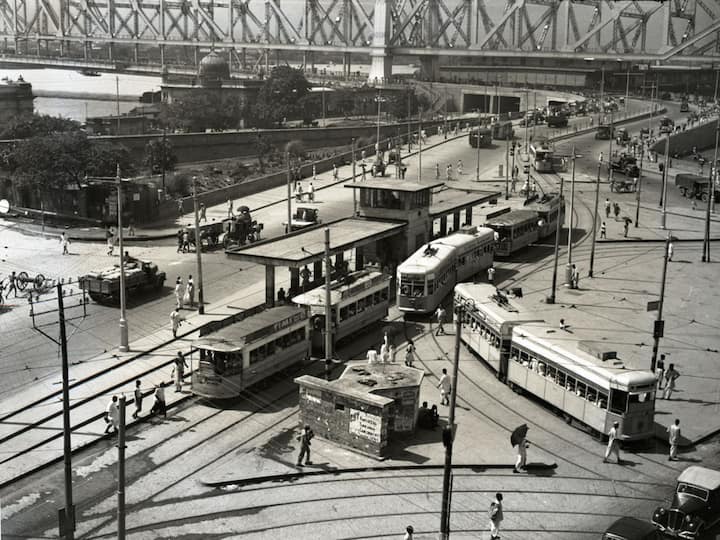
The Tram as a Symbol of Kolkata
For many people, the tram is no longer merely associated with transportation. It has become part of Kolkata's cultural identity. It appears in photographs, films, literature, artwork and travel memories because its silhouette immediately communicates a sense of place.
A yellow taxi may instantly suggest Kolkata.
A hand-pulled rickshaw may suggest Kolkata.
The Howrah Bridge may suggest Kolkata.
And a tram moving beneath its overhead wires can suggest an older, slower and deeply layered version of Kolkata that continues to survive in memory.
The official Calcutta Tramways website itself describes the tram as a vehicle that has witnessed the city's history and gradually become a heritage symbol in its own right.
This transformation is fascinating. The tram was created to solve a transport problem.
It eventually became a cultural symbol.
The engineers who laid the first rails could not have known that more than a century later, people would photograph those same kinds of carriages because they represented nostalgia. The original passengers probably did not imagine that a routine journey could one day become part of the historical imagination of a city.
Yet that is exactly what happened.
Time transformed the tram.
The vehicle remained a vehicle.
But history gave it another meaning.
The Calcutta Tram and the Culture of Time
For a watch brand like CWC — Calcutta Watch Company, the tram offers a remarkably powerful connection between movement, time, engineering and heritage. A tram is a mechanical and electrical object designed around controlled movement. It follows a predetermined route, travelling from one point to another through the changing hours of the day. It has its own rhythm, its own engineering language and its own visual identity.
A watch does something similar on a smaller scale.
Its movement creates controlled motion.
Its hands follow predetermined paths.
Its mechanism transforms energy into a visible journey through time.
The tram moves through the streets.
The hands move across the dial.
Both travel.
Both repeat their journeys.
Both become witnesses to the moments around them.
This connection creates an extraordinary opportunity for a future CWC heritage-inspired timepiece. The design does not need to reproduce a tram literally on a watch dial. Instead, it can take inspiration from the deeper language of the Calcutta Tram: the geometry of rails, the cream-and-colour character of historic carriages, the overhead lines, the old route boards, the movement of steel wheels and the atmosphere of travelling through historic Kolkata.
A seconds hand could reflect the feeling of a journey along the rails.
A dial texture could subtly suggest railway tracks or the city streets through which the tram travelled.
The indices could take inspiration from old route signage or architectural elements associated with historic Calcutta.
The colour palette could quietly connect with the visual identity of the tram without becoming a costume.
The most powerful heritage design is not always literal.
Sometimes, it is enough to make the wearer feel the story.

A Future Collection Inspired by the Rails of Calcutta
A CWC Calcutta Tram-inspired collection could therefore celebrate more than a vehicle. It could celebrate an entire period of urban history. It could speak about the journey from horse power to steam and then to electricity. It could connect 1873, the year of the first horse-drawn tram, with the electric transformation of the early twentieth century and the generations of Kolkata residents who made the tram part of their everyday lives.
The watch could become a small piece of that journey.
Not a miniature tram on the wrist.
But a timepiece inspired by what the tram represents.
Movement.
Engineering.
Heritage.
Urban memory.
The beauty of a city that has never been completely modern and never completely old.
A place where history and the present continue to travel on the same street.
The Vehicle That Refused to Become Just a Memory
More than 150 years after the first horse-drawn tram journey of 1873, the story of the Calcutta Tram remains unfinished. Its history has included expansion, technological change, electrification, modernisation, route closures and ongoing debates about the future of one of Kolkata's most recognisable heritage symbols. But regardless of how the transport system itself continues to evolve, the cultural journey of the tram has already secured a place in the history of the city.
The first tram was created to move people.
Over time, it began carrying memories.
Its wheels travelled through the colonial city and independent India. Its carriages saw generations grow older. Its routes connected places that changed beyond recognition. The city became faster around it, but the tram continued to represent another rhythm—a rhythm in which movement itself could be experienced rather than merely measured.
That may be the Calcutta Tram's greatest legacy.
It taught a city that not every journey needs to be rushed.
Some journeys become meaningful because of what they allow us to see along the way.
For CWC, that idea connects beautifully with the philosophy of a heritage-inspired timepiece. A watch is also a journey. Its hands continue moving even when we stop paying attention. Hours become days, days become years and years eventually become history.
The Calcutta Tram did the same.
It moved.
The city changed.
And slowly, without ever intending to, a vehicle became an icon.

CWC — Calcutta Watch Company
Inspired by the streets that moved through history. Designed for the moments that move with us.
Heritage on Your Wrist.
_________________________________
Explore CWC: Calcutta Watch Company - CWC (Official Website)
Our Socials:
Facebook: https://www.facebook.com/calcuttawatchcompany
Instagram: https://www.instagram.com/calcuttawatchcompany.in/
YouTube: https://www.youtube.com/@calcuttawatchcompany
X (Twitter): https://x.com/thecwcin
WhatsApp: https://www.whatsapp.com/channel/0029Vb8QtxpGk1Fu0BQhvH1Y
Telegram: https://t.me/calcuttawatchcompany


