

Kolkata, Measured in Time
We make things that work better and last longer. Our products solve real problems with clean design and honest materials.
Discover Kolkata's historic clocks, from Howrah's famous Big Clock and New Market's Gillett & Johnston timepiece to St. Andrew's 1835 church clock and the heritage tower clocks of old Calcutta.
Calcutta Watch Company | Kripanti Maity
The Clocks, Timepieces and Tower Bells That Still Tell the Story of a City
There are cities that remember their history through monuments.
Kolkata remembers much of its history through time.
Look closely at the city's old streets and you will find clocks almost everywhere: above markets, churches, railway platforms, government buildings, ports and educational institutions. Some are enormous mechanical machines hidden inside towers. Others were designed as architectural landmarks, their faces visible from busy streets where thousands once depended on them to know the hour.
Long before smartphones, quartz watches and digital displays transformed the way people experienced time, these public clocks performed an essential civic function. They announced the hour to workers, merchants, travellers, sailors, students and pedestrians. Their bells travelled across neighbourhoods. Their hands moved above markets and railway stations. Their mechanisms quietly converted falling weights, gears, pendulums and escapements into something everyone could understand.
Time was public.
And Kolkata's historic clocks became part of the city's public life.
Today, many of those clocks are more than instruments of measurement. They are surviving pieces of mechanical engineering, colonial-era craftsmanship, urban history and architectural heritage.
Some stopped decades ago.
Some were restored.
Some still strike.
And a few continue to stand above the city as if they have been waiting patiently for Kolkata to look up again.
When Time Became a Public Landmark
The idea of a large public clock was particularly important in nineteenth- and early twentieth-century urban life.
Personal watches were expensive and far less common than they are today. A clock placed above a market, railway station or civic building could therefore serve an entire neighbourhood.
The clock was not merely decoration.
It was infrastructure.
It regulated the rhythm of commerce and transportation. Market traders could coordinate opening hours. Railway passengers could judge the departure of trains. Workers could estimate the beginning and end of shifts. Ships and port workers could maintain schedules. Church bells and clock chimes gave an audible dimension to the passing of hours.
In Kolkata, this culture of public timekeeping became especially visible as the city expanded into a major commercial and administrative centre.
The result is an extraordinary collection of historic clocks — each associated with a different part of the city's story.
01 — The Great Clock of Howrah

A Railway Landmark That Became a Meeting Point
Few clocks are as emotionally connected with Kolkata as the enormous clock associated with Howrah Station.
Across the Hooghly, Howrah Station became one of the great gateways into the city. The railway transformed the relationship between Kolkata and the rest of India, bringing passengers, workers, traders and goods into the metropolis on an unprecedented scale.
And above this world of constant movement stood a clock.
Often affectionately called “Boro Ghori” — the Big Clock, it became far more than a timekeeping instrument.
It became a meeting point.
For generations, people arriving in Howrah have used the clock as a visual reference: a fixed object in a landscape of moving trains, crowds and luggage.
Someone would wait beneath it.
Someone would arrive beneath it.
Someone would say, “Meet me near the big clock.”
That simple sentence transformed an industrial timepiece into part of the emotional geography of Kolkata.
Historical accounts associate the Howrah clock with the British manufacturer Gents of Leicester, whose clocks became widely used for public and institutional timekeeping. Kolkata's heritage-clock tradition also preserves the story of British manufacturers supplying sophisticated tower clocks to Indian institutions.
The significance of the clock therefore goes beyond its mechanism.
It represents the moment when railway time became city time.
The railway demanded precision. Trains could not operate according to the vague rhythms of sunrise, sunset and local routine. Standardised schedules required clocks that could be trusted.
The railway station became one of the places where modern mechanical time became visible to ordinary people.
And in Howrah, that time was given a face.
02 — New Market's Four-Faced Timekeeper
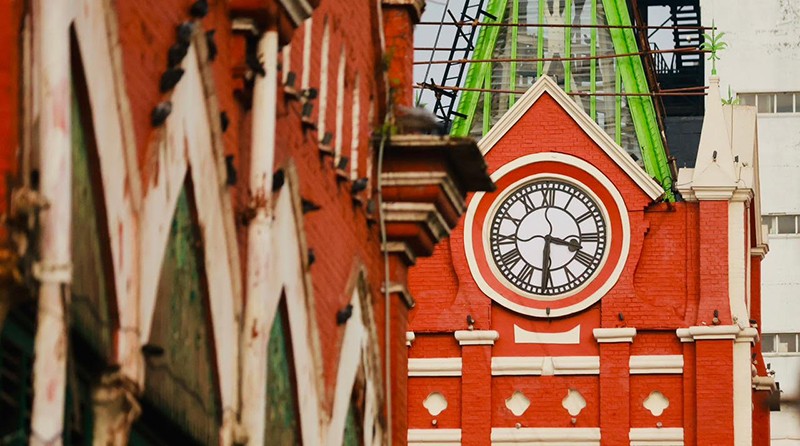
The Westminster Clock Above Kolkata's Most Famous Market
If Howrah's clock represents movement, New Market's clock represents commerce.
The market opened in 1874 as the market that later became popularly known as New Market, or historically as Sir Stuart Hogg Market. Designed in the Victorian Gothic tradition, it became one of colonial Calcutta's most important commercial spaces.
But the market's famous clock tower arrived later.
The historic clock was brought from Huddersfield, England, and installed in the 1930s. Historical accounts identify it as a Gillett & Johnston clock, a manufacturer renowned for tower clocks and bells.
The tower's four faces allowed the time to be read from different directions.
Inside was an intricate mechanical system.
Weights descended gradually.
Gears transferred motion.
The escapement regulated the movement.
And the mechanism operated the hands and chimes.
The clock was designed to be heard as much as seen.
Its Westminster-style chimes once rose above the noise of the market — above conversations, carts, footsteps, vendors and the enormous rhythm of commercial Kolkata.
That is what makes New Market's clock particularly fascinating.
It was not isolated from urban life.
It was designed to become part of it.
The clock stopped functioning in 2018, after years of deterioration and structural problems. Restoration work eventually began, including repairs to the historic tower and the clock mechanism. In 2026, the restored Gillett & Johnston clock was reported to have returned to operation after years of silence.
The revival is significant because restoring a tower clock is not simply a matter of replacing a battery.
It means understanding an old mechanical system.
It means preserving original components where possible.
It means respecting the relationship between the clock and the building around it.
And it means allowing a historic soundscape to return.
03 — St. Andrew's Church

The Clock That Went Silent — and Chimed Again
In the heart of the historic Dalhousie Square district stands St. Andrew's Church, an important landmark of old Calcutta.
The church itself dates to the early nineteenth century, with its foundation stone laid in 1815 and consecration taking place in 1818. Its tower incorporated a clock in 1835, creating one of Kolkata's oldest surviving public timepieces.
The clock was manufactured by James McCabe, Royal Exchange, London.
Nearly two centuries later, the name of its maker remains associated with the mechanism.
That alone tells us something about the philosophy of nineteenth-century clockmaking.
These were not disposable objects.
A well-made tower clock was designed to serve for generations.
The St. Andrew's clock became famous for its chimes. It struck at the quarter hours and on the hour, allowing its sound to travel through the surrounding streets.
Then, for almost a decade, the sound disappeared.
The mechanism eventually fell silent.
In 2024, however, clock restorers Swapan Dutta and his son Satyajit Dutta restored the mechanism after extensive work, bringing the historic clock back into operation. The restoration was supported by the citizens' collective Kolkata Restorers.
There is something profoundly poetic about this.
A city that had changed almost beyond recognition was once again hearing the same clock that had marked time in an earlier Calcutta.
The buildings around it had changed.
The traffic had changed.
The language of commerce had changed.
But the mechanism still knew how to count.
04 — The General Post Office Clock

Where Time Meets Communication
The General Post Office of Kolkata is one of the city's most recognisable architectural landmarks.
Its enormous dome rises above the BBD Bagh district, occupying a site deeply connected with the city's colonial administrative history.
And high above the building is another reminder of the importance of public time.
The GPO clock belongs to an era when postal communication itself represented modernity.
Letters, telegrams, parcels and official documents moved through an increasingly organised network. The post office connected Kolkata with cities, towns and people far beyond Bengal.
Time was essential to that network.
Mail had schedules.
Trains had schedules.
Postal workers had schedules.
Business houses depended on predictable deliveries.
The clock therefore belonged naturally to the architecture of communication.
Historical accounts describe the GPO building as designed by Walter B. Greville/Granville in the nineteenth century, with the clock associated with the building's colonial architectural conception.
The building's clock is particularly striking when viewed from the streets surrounding BBD Bagh.
It is not a small detail.
It was conceived as part of the building's identity.
The clock tells you where the building stands, just as the building tells you where the city once organised its communication.
05 — Kidderpore Clock Tower
A Clock That Watched the Port
Some of Kolkata's most intriguing clocks are found away from the obvious tourist routes.
One of them stands near Kidderpore Port.
The clock tower was erected in 1899 by the Commissioners of the Port of Calcutta. Historical accounts describe it as having served as a timekeeper for ships and port activity.
This is an entirely different dimension of Kolkata's horological history.
The city was not only a place of markets and railways.
It was a port city.
The Hooghly connected Kolkata to the Bay of Bengal and to maritime trade routes stretching across the world. Ships required schedules. Cargo operations required coordination. Workers needed reliable time. Port administration depended upon predictable movement.
A clock near the harbour therefore became part of an enormous international machine.
Every tick belonged to a wider system of commerce.
The nearby Indenture Memorial adds another layer to the site's history. Between the nineteenth and early twentieth centuries, large numbers of Indian labourers departed through Kolkata's port under the indenture system, making the waterfront a place connected to one of the most consequential and painful chapters of the colonial era.
The clock consequently stands in a landscape where time, trade, migration and empire intersect.
06 — The IIEST Shibpur Clock

A Gift That Became an Engineering Monument
Across the river from Kolkata, at the historic campus of the Indian Institute of Engineering Science and Technology, Shibpur, stands another remarkable tower clock.
Its story is different.
It was not primarily built as a railway landmark or market clock.
It was a gift.
In 1919, industrialist and alumnus Sir R. N. Mookerjee presented the massive tower clock to the institution. The clock was manufactured by Gillett & Johnston of Croydon, England.
The connection is especially fascinating because Gillett & Johnston became one of the world's important manufacturers of tower clocks and bells.
The Shibpur mechanism is an impressive piece of mechanical engineering.
According to IIEST's own documentation, the mechanism incorporates an escapement system, precision spur and bevel gearing, ratchet and cam mechanisms, a large bell and a gravity-driven system. The clock contains around 120 major mechanical components that must operate in synchronisation.
Think about what that means.
No battery.
No microprocessor.
No electronic sensor.
No internet connection.
Just carefully engineered mechanical components interacting with gravity and controlled motion.
And the mechanism tells time.
That is horology at its most elegant.
The Clockmakers Behind Kolkata's Clocks
A fascinating part of Kolkata's clock history is that the names of the manufacturers often survive alongside the buildings.
James McCabe.
Gillett & Johnston.
Gents of Leicester.
Cooke & Kelvey.
These were not merely suppliers of decorative objects.
They belonged to a sophisticated international horological industry.
British manufacturers produced tower clocks for railway stations, churches, markets, civic buildings and institutions throughout the world.
Their machines were engineered to operate in large public structures, often under demanding conditions.
Kolkata became one of the cities where this technology found a permanent home.
And the clocks became architectural signatures.
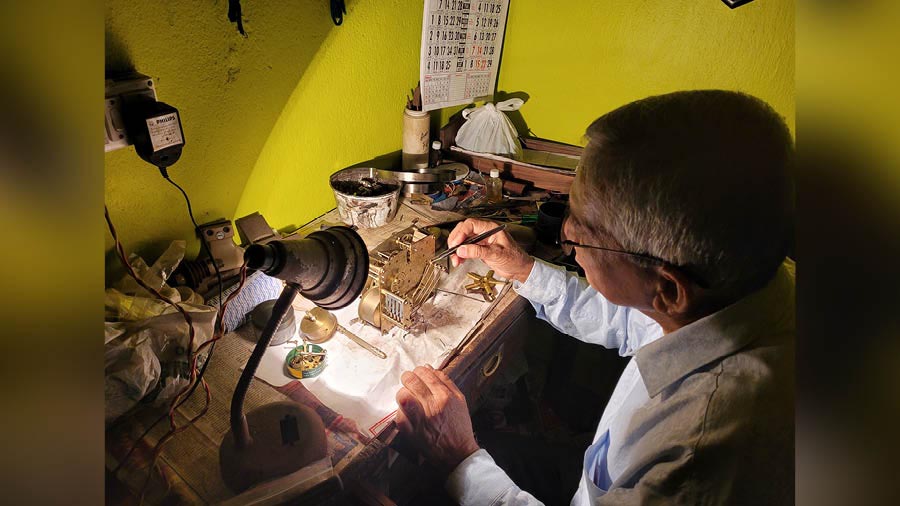
The People Who Keep the Clocks Alive
A historic clock may be made from brass, steel, cast iron, wood and glass.
But none of those materials can repair themselves.
Behind every functioning heritage clock is another form of heritage:
the clockmaker.
Kolkata has its own tradition of specialist clock repairers.
The Dutta family, for example, has been associated with maintaining tower clocks in Kolkata for generations. Historical reporting has documented the work of P. P. Dutta & Sons, whose family tradition extends across five generations.
This is an important part of conservation that is often overlooked.
Preserving a clock does not simply mean preserving its dial.
The real heritage is hidden inside.
A clock's hands may be visible from hundreds of metres away, but its soul is inside the mechanism.
A restorer must understand escapements, gears, bearings, pendulums, weights, striking trains and winding systems.
In a sense, the clockmaker is translating between centuries.
Why These Clocks Were So Important
Today, almost everyone carries a clock in their pocket.
A smartphone can display the exact time down to the second.
That has fundamentally changed our relationship with public clocks.
But in nineteenth-century Kolkata, a tower clock could be one of the few reliable ways for an entire neighbourhood to know the time.
That explains why these clocks were often placed in strategic locations.
Markets needed time.
Railways needed time.
Ports needed time.
Churches needed time.
Government offices needed time.
Schools and institutions needed time.
The clock tower was therefore a piece of public infrastructure disguised as architecture.
And its position above the city gave time a physical presence.
When the City Learned to Hear Time
There is another reason Kolkata's clocks remain special.
They did not merely show time.
They sounded it.
A quarter-hour chime.
A half-hour strike.
The deep resonance of an hourly bell.
These sounds once travelled through the streets.
Imagine nineteenth-century Dalhousie Square.
No smartphone notifications.
No digital billboards.
No constant engine noise.
Instead, a distant bell announces the passing quarter.
A clock strikes somewhere above the city.
People hear it and continue walking.
That sound becomes part of the urban landscape.
This is why restoring a heritage clock can restore more than a mechanism.
It can restore a soundscape.
The return of St. Andrew's Church's chimes after years of silence demonstrated precisely this. People did not merely notice that the hands had started moving again; they noticed that the city had regained a sound from its past.
Kolkata's Clocks and the Architecture of Time
Kolkata's historic clocks also reveal something about architecture.
A clock tower has to be seen.
That requirement influences its height, position and proportions.
The clock face becomes an architectural focal point.
The tower rises above the surrounding roofline.
The mechanism occupies a protected chamber.
The bell requires space to resonate.
The structure must carry weight and withstand vibration.
This is why the best historic clock towers are not simply buildings with clocks attached.
The architecture was designed around the timepiece.
At New Market, the clock becomes part of the Victorian Gothic silhouette.
At St. Andrew's Church, it rises through the ecclesiastical tower.
At the GPO, the clock participates in the monumental language of the building.
At Shibpur, it becomes an engineering landmark.
Each one expresses time differently.
From Mechanical Time to Digital Time
The transformation of Kolkata's clocks mirrors the transformation of the city itself.
The nineteenth century brought mechanical public time.
The twentieth century brought wristwatches, electric clocks and increasingly precise timekeeping.
The twenty-first century brought smartphones, GPS synchronisation and digital displays.
The practical necessity of the tower clock gradually disappeared.
But its cultural value increased.
That is the paradox of heritage.
The less necessary something becomes, the more clearly we sometimes see what it meant.
A clock that once existed because people needed it can survive because people remember it.
The New Clock Towers of Kolkata
Kolkata has not completely abandoned the idea of the clock tower.
In recent decades, several newer clock towers have appeared across the city.
The most prominent example is the large clock tower at Lake Town, designed in the visual language of London's Big Ben and completed in the mid-2010s. Other replicas and clock towers subsequently appeared in different parts of the city.
These newer structures are very different from the nineteenth-century mechanical clocks.
They are less about regulating everyday life and more about creating landmarks.
That difference is revealing.
The old clock tower was often an essential machine.
The new clock tower is primarily an urban symbol.
The technology changed.
The fascination did not.
A City That Still Counts the Hours
Walk through Kolkata today and the city can feel overwhelmingly modern.
Cars move through streets that once carried horse-drawn carriages.
Metro trains pass beneath neighbourhoods that once relied on trams.
Smartphones have replaced pocket watches.
Digital boards have replaced many public clocks.
Yet above the city, the old timekeepers remain.
The clock at New Market.
The great clock associated with Howrah Station.
The clock of St. Andrew's Church.
The clock above the General Post Office.
The Kidderpore clock tower.
The Gillett & Johnston mechanism at Shibpur.
They belong to different buildings, different communities and different chapters of history.
But they share one language.
Time.
Why Kolkata's Clocks Matter to Watch Enthusiasts
For a watch enthusiast, these clocks offer something that a photograph of a famous building cannot.
They reveal the mechanical philosophy of timekeeping.
A wristwatch reduces a complex mechanical system to something that can fit around the wrist.
A tower clock expands that same principle into architecture.
The escapement still regulates motion.
The gear train still transfers energy.
The pendulum still controls rhythm.
The striking train still announces the hour.
The hands still translate mechanical movement into something the human eye understands.
The scale is different.
The principle is remarkably familiar.
This is why historic tower clocks deserve a special place in horological history.
They are essentially architecture-sized watches.
Kolkata's Most Remarkable Timekeepers
| Timepiece | Location | Historical significance |
|---|---|---|
| Howrah Station Big Clock | Howrah | A legendary railway landmark and meeting point |
| New Market Clock | Lindsay Street | Gillett & Johnston four-faced Westminster-style clock |
| St. Andrew's Church Clock | Dalhousie Square | 1835 James McCabe clock with historic chimes |
| GPO Clock | BBD Bagh | Landmark of Kolkata's historic postal district |
| Kidderpore Clock Tower | Kidderpore | 1899 port timekeeper linked to maritime history |
| IIEST Shibpur Clock | Shibpur | 1919 Gillett & Johnston engineering masterpiece |
The Hands Keep Moving
Perhaps the most beautiful thing about Kolkata's historic clocks is that they have witnessed almost everything.
Empire.
Independence.
Partition.
Industrialisation.
The rise of railways.
The decline of certain colonial institutions.
The birth of modern India.
The transformation of Calcutta into Kolkata.
They watched generations arrive and disappear.
They watched buildings change.
They watched streets become crowded.
They watched technology make them unnecessary.
And yet, whenever one of these clocks is restored and begins ticking again, something remarkable happens.
For a moment, the distance between past and present becomes smaller.
The mechanism starts moving.
The hands begin their slow journey around the dial.
And somewhere beneath the modern city, an old rhythm returns.
Time, Preserved
Kolkata's historic clocks are not simply monuments to the British period.
They are monuments to the history of time itself.
They tell us how a city learned to organise commerce, transport, communication and public life around mechanical precision.
They tell us about engineering and craftsmanship.
They tell us about architecture.
They tell us about the people who built, maintained and listened to them.
Most importantly, they tell us that a city's heritage is not always found in its grandest monuments.
Sometimes it is hidden inside a clock tower.
Behind a weathered dial.
Inside a room of gears.
In the slow descent of an iron weight.
In the swing of a pendulum.
In the sound of a bell travelling through an old street.
And perhaps that is why Kolkata's clocks remain so compelling.
Because while the city has changed almost beyond recognition, they continue to do the one thing they were built to do.
They keep time.
And Kolkata keeps its memories with them.
Editorial Note
The history of Kolkata's public clocks contains a mixture of well-documented institutional records, restoration reports and long-standing local traditions. Where historical sources differ on exact installation dates or manufacturer details, this article follows the strongest available evidence and avoids presenting uncertain claims as absolute fact. The Kolkata Municipal Corporation maintains an official heritage inventory of historically significant buildings, while institutional and contemporary restoration records provide additional evidence for individual clocks.
SEO Title
Kolkata's Historic Clocks: The Timepieces That Shaped a City
Meta Description
Discover Kolkata's historic clocks, from Howrah's famous Big Clock and New Market's Gillett & Johnston timepiece to St. Andrew's 1835 church clock and the heritage tower clocks of old Calcutta.
SEO Tags
Kolkata historic clocks, Kolkata heritage clocks, famous clocks in Kolkata, Calcutta clocks, historic timepieces Kolkata, Kolkata clock towers, old Calcutta clocks, Howrah Station Big Clock, Boro Ghori Howrah, New Market clock tower, Gillett Johnston Kolkata, St Andrews Church clock Kolkata, Kolkata GPO clock, Kidderpore clock tower, IIEST Shibpur clock, heritage of Kolkata, Kolkata history, Calcutta heritage, colonial Kolkata, mechanical clocks India, tower clocks India, Indian horology, Kolkata horology, Calcutta Watch Company, CWC, heritage watches India
Hashtags
#Kolkata #Calcutta #KolkataHeritage #CalcuttaHeritage #HistoricClocks #KolkataHistory #CalcuttaHistory #TowerClocks #MechanicalClocks #Horology #IndianHorology #WatchHeritage #HowrahStation #NewMarketKolkata #CalcuttaWatchCompany #CWC #HeritageOnWrist


