

The Dome That Carried a City’s Letters
We make things that work better and last longer. Our products solve real problems with clean design and honest materials.
Kolkata’s General Post Office is more than a grand colonial landmark beneath a magnificent dome. From the earliest days of Calcutta’s postal history to the countless letters, telegrams, parcels and personal stories that passed through its halls, the GPO has spent centuries connecting a city to the wider world. Standing at B.B.D. Bagh on the historic grounds of old Fort William, it remains a timeless monument to communication, memory and the human desire to overcome distance.
Calcutta Watch Company | Kripanti Maity
The Story of Kolkata’s General Post Office
There are buildings that define a city through power, some through wealth, and some through memory. Kolkata’s General Post Office, standing beneath its immense dome at B.B.D. Bagh, belongs to the last category. For more than a century and a half, this monumental building has stood as a silent witness to letters arriving from distant continents, telegrams carrying urgent news, parcels travelling across oceans, and countless handwritten messages that connected one human life to another. Before the age of instant notifications, video calls and glowing smartphone screens, a letter was often the closest thing to carrying a person’s presence across distance—and somewhere within the great machinery of colonial and later independent Kolkata, the General Post Office became one of the city’s most important gateways for those journeys. Even today, while modern traffic moves relentlessly around B.B.D. Bagh, the great dome of the GPO seems to belong to another rhythm: slower, grander and filled with the memory of paper, ink, sealing wax and waiting.
The story of the present General Post Office is inseparable from the story of old Calcutta itself. The building stands in the historic heart of the city, in the area once known as Dalhousie Square and today called B.B.D. Bagh. This was not simply another neighbourhood. It was one of the great administrative centres of British India, surrounded by institutions that represented government, commerce and imperial authority. Yet long before the familiar white dome appeared on Kolkata’s skyline, the land carried an even older history. The site of the GPO formed part of the location of the original Fort William, one of the earliest and most significant symbols of British power in Calcutta. The eastern side of the building still bears a marker associated with the boundary of the old fort, reminding visitors that beneath the postal history lies an even deeper layer of the city’s past. Nearby history is also connected with the site traditionally associated with the 1756 “Black Hole of Calcutta,” an episode whose historical account and details have long been debated by historians. The GPO, therefore, was never built on an empty page. It rose on ground already crowded with memory, conflict, empire and the transformation of a trading settlement into one of the most important cities in Asia.
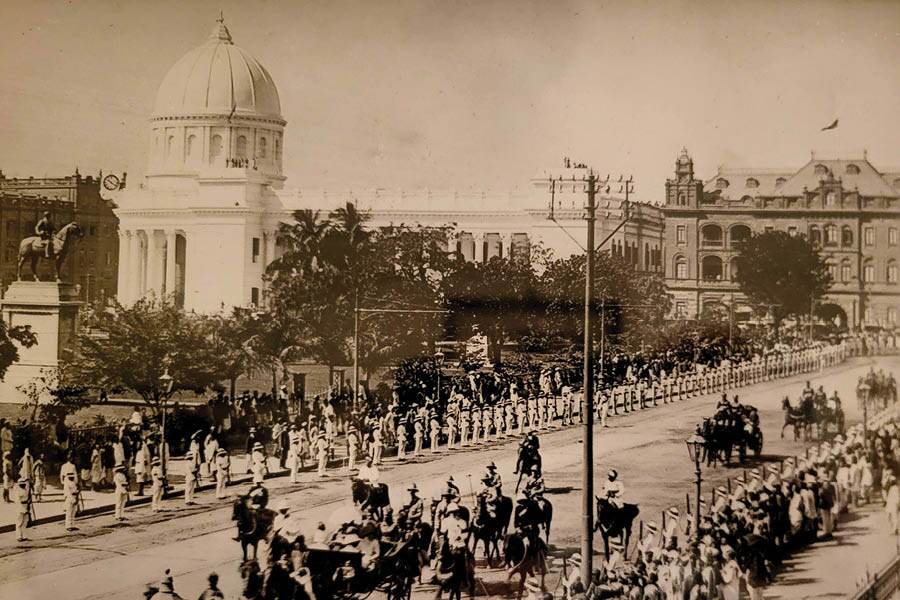
The magnificent building that Kolkata recognises today was constructed between 1864 and 1868 and designed by Walter B. Grenville, who served as a consulting architect to the Government of India during that period. Its architecture was meant to communicate permanence. The enormous central dome dominates the composition, while long symmetrical wings and rows of classical columns create a sense of ceremony and order. The building draws strongly from the grand European classical vocabulary that shaped much of the monumental architecture of the British Empire, with its imposing pillars, balanced proportions and theatrical sense of scale. But in Kolkata, surrounded by tropical light, monsoon skies, tram bells, river air and the restless energy of an Indian metropolis, this European architectural language became part of a distinctly Calcutta landscape. The result was more than a government building. It became one of the city’s visual signatures—so familiar that generations of photographs, postcards and memories have preserved its dome as one of the unmistakable symbols of old Kolkata.

It is easy today to underestimate what a post office once meant to a great city. In the nineteenth and early twentieth centuries, communication moved at the speed of ships, trains, horses and human hands. A letter could take days, weeks or months to reach its destination. News of a birth, a death, a business opportunity, a military posting or a loved one’s safe arrival often travelled folded inside an envelope. Kolkata, then one of the most important ports and administrative centres of British India, needed a vast communications network to remain connected with the rest of the subcontinent and the wider world. The General Post Office stood at the centre of that system, handling enormous flows of inbound and outbound correspondence and parcels. Through its counters and sorting spaces passed official documents and commercial papers, but also the far more intimate history of ordinary people: letters from homesickness, letters of love, letters of hope, letters carrying money, photographs and news from families separated by geography.
Imagine the Kolkata of another age. Outside the great building, horse-drawn carriages once moved through the streets around Dalhousie Square. Clerks in formal dress hurried between offices. Merchants waited for correspondence that could decide the fate of a shipment. Sailors and travellers carried news from distant ports. Somewhere inside the GPO, sacks of letters were opened, sorted and sent onward through an expanding network of roads, railways and ships. Each envelope was small, but together they formed an invisible map of human relationships. The building was, in many ways, a machine for distance. It transformed private handwriting into movement, turning words written in one room into objects capable of crossing cities, mountains, borders and oceans.
That human connection is perhaps the most beautiful part of the GPO’s story. A great post office is built from stone and steel, but its true purpose has always been emotional. The building itself may appear formal and monumental, yet the things that travelled through it were often deeply personal. A father writing to a son studying abroad. A young woman waiting for a letter from another city. A soldier sending news home. A businessman waiting for a contract. A family opening an envelope after weeks of uncertainty. In an age before instant communication, waiting was part of the experience of love and life. A letter did not simply deliver information; it carried anticipation. And Kolkata’s GPO became one of the places through which that anticipation passed.
The building’s grandeur also reflected the extraordinary importance of Kolkata during the period in which it was created. B.B.D. Bagh was surrounded by the institutions of administration and power, including the Writers’ Building and other major colonial-era landmarks. The entire district functioned as one of the great nerve centres of the city. Yet the GPO had a role unlike that of the offices around it. Government buildings exercised authority within their walls; the post office extended its influence beyond them. Its network reached outward—to villages and towns, railway stations and ports, other Indian cities and foreign countries. In this sense, the GPO was both monumental and democratic. A grand dome rose above the city, but beneath it passed messages from every level of society.
One of the most enduring cultural worlds connected with the General Post Office is the world of stamps. For generations, the arrival of a letter was also an encounter with a tiny piece of art. Stamps carried portraits, monuments, national events, scientific achievements, freedom movements, wildlife and stories from across India. The Kolkata GPO continues to hold an important philatelic role, and its Philatelic Bureau preserves the tradition of collecting commemorative stamps and related postal material. In an age when a message can disappear from a phone screen in seconds, there is something wonderfully permanent about a stamp: a small printed object created to travel, to be marked by time and eventually to become a historical record of the world in which it was sent.
The General Post Office also tells a fascinating story about the changing meaning of technology. When the building was new, the postal system represented modern connectivity on an enormous scale. The arrival of faster transport and increasingly organised communication networks changed how business and government operated. Later came the telephone, telegraph, fax machine, email and the internet. Every new invention seemed to make the world smaller. Yet the GPO survived because physical communication never disappeared completely. Parcels still need to travel. Documents still need to be delivered. Stamps are still collected. And somewhere, even in the digital age, people continue to understand the difference between receiving a notification and receiving something that another human being has physically written, addressed, sealed and sent.
That is why the GPO remains more than a colonial monument. Its history is not frozen in the nineteenth century. It continues as a working institution, serving as Kolkata’s central post office and the chief postal office of West Bengal, while still standing as one of the city’s most recognisable architectural landmarks. This continuity gives the building a rare kind of character. It is not merely preserved for tourists behind a fence. It continues to perform the function for which it was created, even as the world around it changes at extraordinary speed.

And perhaps that is the most powerful way to look at Kolkata’s General Post Office today. Do not see only the dome, the columns or the symmetry of its grand façade. Think instead of the invisible journeys that have passed through it. Think of a letter written under a dim lamp more than a hundred years ago, travelling by ship and train through systems of sorting and delivery. Think of postcards carrying a glimpse of Calcutta to another continent. Think of official envelopes that helped govern an empire, and private envelopes that meant everything to the person waiting at home. The GPO has carried both the machinery of history and the fragile emotions of everyday life.
Standing before the building now, one can almost imagine the city’s past still moving through its corridors. The ink may have faded, the handwriting may be forgotten and the people who wrote those letters may have disappeared into history, but the great dome remains. It has watched Calcutta become Kolkata. It has seen colonial rule give way to independence, handwritten correspondence give way to digital communication, and a city once governed from across the seas become a modern Indian metropolis speaking to the entire world in its own voice.
The General Post Office is, ultimately, a monument to connection. Its columns may have been built to project grandeur, and its dome may have been designed to dominate the skyline, but its deepest legacy lies in something far more human: for generations, this was one of the places where distance was defeated, where waiting found an answer, and where a city sent pieces of itself out into the world—one letter at a time.


